Friday, September 24, 2004

Chrenkoff brings Kerry down to size.

"Face it, you and your merry company are just a pimple on the ass of an asterisk in a footnote of the history of progress from tyranny to freedom."

Arthur Chrenkoff, commenting on the "only happy when it rains" attitude of Senator Kerry and his comrades towards Iraq, as demonstrated recently by his putdown of Iraqi Interim Prime Minister Ayad Allawi's speech at the U.N.

Gregory Djerejia ("Belgravia Dispatch") isn't too happy with Kerry, either.

Thursday, September 23, 2004

Love it or leave it?

Commenting on Victor Davis Hanson's editorial in the Wall Street Journal ("The U.N.? Who Cares?" Sept. 23, 2004), Thomas Krannawitter has a good suggestion for Kofi Annan:

But nations that don’t know the principles or language of freedom will never achieve freedom. Hanson is right to point out that, “Like the U.N. membership itself, [Kofi Annan] enjoys the freedom, affluence and security of a New York, but never stops to ask why that is so or how it might be extended to others less fortunate.”

If the United Nations does not think of America as a model of freedom to be followed by others around the globe -- if America is merely one among many nations, neither better nor worse but only different -- then maybe the U.N. should seriously consider relocating itself to some place such as…oh, maybe Libya. Any nation responsible enough to chair the United Nations Human Rights Commission should be responsible enough to host the United Nations, right?

Or maybe the United Nations might move to Sudan? It might be instructive: when the Human Rights Commission meets to discuss violations of human rights, they could simply look out the window to witness beatings, gang rapes, and enslavement. What could make their discussions more edifying?

How about it, Kofi? -- It's been said that "absence makes the heart grow fonder."

Tuesday, September 21, 2004

Rathergate and Postmodernism

Frederick Turner derives a philosophical lesson from 'Rathergate' ("The Blogosphere and the Pajamaheddin"):

For the last thirty years or so academic Humanities departments throughout the country had been teaching writing through the discipline of rhetoric, based on deconstructive theories of the indeterminacy and self-destructiveness of any text. Since words can only be defined by other words, and cannot refer outside the language world to self-sufficient present realities, the only valid speech or writing was that which persuades others, and enacts the power interests of the discourse-community with the highest political ideals. The concept of truth, of the "transcendental signified," had been parsed into absurdity: everything depended on what the meaning of is is, as our former President so ingeniously put it.

Journalists in the mainstream media had imbibed these ideas with their education, and had melded them with the enthusiasm and hero-worship they had lavished on the intrepid reporters of the Watergate and Iran-Contra scandals. But in the process, fact-checking, critical editing, and sound research had all begun to erode. . . .

The new tone that entered the blogosphere was a sense of responsibility to the truth. The bloggers looked around themselves and saw that nobody else had the powerful means, the democratic and distributed organization, the robust egalitarian truculence, and the absence of interest conflict to act as the truth's final guardian and court of appeal. The mainstream journalists had abdicated their responsibility, the political parties were obviously willing to bend the truth, the academy had philosophically repudiated the concept of truth, the courts were increasing based on adversarial rhetorical virtuosity, rather than the establishment of fact. So it was up to the bloggers.

Monday, September 20, 2004

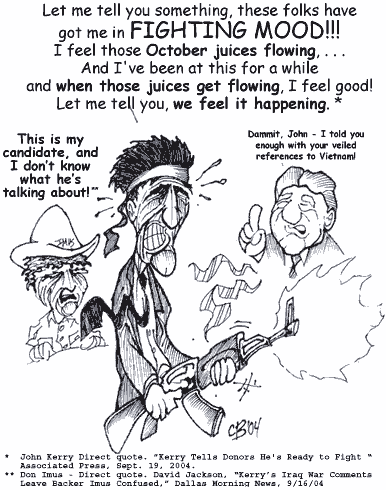
Juiced-Up John Kerry in a "Fighting Mood"

Cartoon by yours truly; inspired by blogger Tim Blair.

Quick! Warn your friends! -- buy the postcard!
greeting cards also available).

Sunday, September 19, 2004

When Journalism Meets Reality

. . . This is a hard issue for journalists who want to be fair to partisans on both sides of the issue. Perhaps this small but symbolic action is, somehow, linked to the Peterson case. Perhaps it is linked to the growing use 4D ultrasound technology.

Then again, perhaps it is a concession to reality, to the words that people use in real life. This is not politics. It is a matter of simple humanity. Faced with this kind of tragedy, loved ones and public servants do not tell journalists "we lost a fetus."

No, they lost the baby. They lost a child, an "unborn child." It is awkward or even cruel to say anything else.

TMatt, from the blog "Get Religion" (Ghost in the stylebook: Death of an unborn child).

Friday, September 17, 2004

Nice to know we still matter. =)

. . . Queens today is often remembered primarily as the home of All in the Family’s Archie Bunker, the loudmouthed, blue-collar bigot invented by ultra-liberal Norman Lear. Bunker debuted during the Lindsay years, when the liberals looked with horror at how ordinary New Yorkers, especially from Queens’s ethnic neighborhoods, furiously resisted many of the progressive nostrums that Lindsay and his circle tried to force on them. Though Bunker evolved into a sort of genial, cartoonish figure, the show was part of a contemptuous assault against the ideals and values of the country’s blue-collar, family-oriented, ethnic middle class by the liberal elites of the time, who viewed resistance to their agenda as raw bigotry. But the citizens of Queens, for the most part, were not bigots, as Lear depicted them; and they were much wiser than John Lindsay, as the decline and revival of Queens -- and of New York as a whole -- makes clear. Let’s hope that the Manhattan elites don’t try to ride roughshod over the values and interests of the borough again. It won’t be just Queens that suffers.

"Why Queens Matters", by Stephen Malanga.
City Journal Summer 2004.

John Kerry: Please. Shut. Up. About. VIETNAM.

Kimberly Strassel has an amusing editorial on John Kerry's pathetic attempts to suck up to the NRA ("Ready, Aim, Fire . . . Hit Foot" Wall Street Journal Sept. 17, 2004), culminating in this excerpt from an upcoming issue of Outdoor Life:

The October edition of Outdoor Life will feature interviews with both presidential candidates. When asked about their favorite guns, President Bush responds: "My favorite gun is a Weatherby Athena 20 gauge." Mr. Kerry says (reminding us yet again where he was 35 years ago): "My favorite gun is the M-16 that saved my life and that of my crew in Vietnam. I don't own one of those now, but one of my reminders of my service is a Communist Chinese assault rifle." So Mr. Kerry's favorite gun is an "assault" rifle designed for war. Funny talk coming from a guy who just went ballistic over the end of the "assault" weapons ban.

I thought Bill Clinton called you from the hospital and advised you to cease and desist with all references to Vietnam?

Please, it's really getting old.

Thursday, September 16, 2004

Kerry Supporter Harasses Three-Year-Old

I don't care how mad you are at the President -- taking out your frustrations on a three-year-old by ripping up her 'Bush/Cheney' sign is bad form. Updates:
  • Here is a second photograph of the incident.

  • Was it staged as liberal blogger "Rising Hegemon" claims? -- The father, at least, has a habit of showing up at Democratic rallies with Bush/Cheney signs.
  • Washington Times has the story.
  • Update: Michelle Malkin has refuted the liberal claim that it was a hoax. Amazing how quickly the blog fact-checking machine springs into action. CBS should take lessons.

The U.N. fiddles . . .

. . . as Syria tests chemical weapons on human guinea pigs in Darfur.

Andrew C. McCarthy comments at the National Review:

I should mention the widely reported hypothesizing that Syria may have received chemical weapons from Saddam Hussein's deposed regime in the run-up to the U.S. invasion of Iraq; that Syria is undoubtedly assisting the Baathist element of the Iraqi terrorist resistance; that the CIA and international proliferation experts have recently expressed concerns that Syria is actively attempting to develop nuclear weapons to go with its already thriving chemical program; and that, for all the attention grabbed by Hamas and Arafat, it is Syria that may pose the greatest immediate, existential threat to Israel. But if I mentioned those things, I might be taken by unnamed intelligence sources for a Likud-controlled neocon who should be investigated by the FBI on suspicion of believing Iran is dangerous, Saddam cavorted with terrorists, and other equivalent felonies.

I would note this, though: I don't know if I'd be holding my breath waiting for Turtle Bay to plumb the depths of the Syria/Sudan chemical-weapons partnership. Reflecting its deep concern for the human condition, the U.N., you may recall, has an esteemed component it portentously calls the "United Nations Commission on Human Rights." The U.S. was, indeed, a founding member. But a while back, we could not garner enough votes from member nations to maintain our seat. We were replaced by...Syria.

"U.N.: What Is It Good For?", NRO. Sept. 16, 2004

"I am a Republican"

An anonymous individual, describing himself only as "Mr. X.", confesses in the New York Sun:

You know me. If you don't, you've seen me...eating dinner in a midtown restaurant or walking up Broadway on a Saturday morning or sitting at the playground in the park as my child climbs the monkey bars. I take the subway to work every morning like thousands of other New Yorkers. I shop at Fairway and Zabar's. Maybe you've even been sweating on the next treadmill at the gym. I look like a hundred other guys around my age. I dress like them, too. And if you saw me, you would never guess my secret.

I am not gay. That is certainly no reason to hide. I am not a person of color. That prejudice should have been erased from our national consciousness decades ago. I don't carry any disease microbes that I am aware of. I don't even smoke.

But the information that I will now transmit has caused people to shout at me, brought dinner parties to an abrupt end on less then polite terms. It has even ended long friendships.

Here it is. I will just say it. I am a Republican.

The article has provoked quite a response from readers of The New York Sun, resulting in numerous letters to the editor from like-minded sympathizers.

Don Imus: "This is my candidate, and ... I don't know what he's talking about."

Don Imus, host of the famous radio talk show 'Imus in the Morning', had the opportunity to interview Kerry the other day:

IMUS: You said, Senator Kerry, a while back, not that long ago -- and I assume you meant all of the things you're talking about now, but you said knowing what you know now, which would include just what you've been talking about, you would have still voted to authorize the use of force in Iraq, which doesn't make any sense to me.

KERRY: Yes, it actually does make sense.

IMUS: Explain it. Help me out here. . . .

Senator Kerry proceeded to lay his "policy on Iraq" out on the table for the befuddled Imus (transcript). Eventually, things came to a head:

KERRY: I mean, what you ought to be doing and what everybody in America ought to be doing today is not asking me; they ought to be asking the president, What is your plan? What's your plan, Mr. President, to stop these kids from being killed? What's your plan, Mr. President, to get the other countries in there? What's your plan to have 90 percent of the casualties and 90 percent of the cost being carried by America?

IMUS: We're asking you because you want to be president.

Don Imus would later reflect on the occasion (Kerry's Iraq war comments leave backer Imus confuse" Dallas Morning News Sept. 15, 2004):

"I was just back in my office banging my head on the jukebox," Mr. Imus said. "This is my candidate, and ... I don't know what he's talking about."

(Thanks Tim Blair).

Orson Scott Card: "Which terrorists are our enemies?"

Orson Scott Card asks "Which Terrorists Are Our Enemies?"

How many other Science Fiction authors do you know who are this unabashedly Republican?

John Kerry's coercion of Vietnam Vet Steve Pitkin

Wintersoldier.com on John Kerry's manipulation of Vietnam Vet Steve Pitkin:

. . . On the second day of the conference, Pitkin was surrounded by a group of the event's leaders, who said they needed more witnesses and wanted him to speak. Pitkin protested that he didn’t have anything to say. [John] Kerry said, "Surely you had to have seen some of the atrocities." Pitkin insisted that he hadn't, and the group's mood turned menacing. One of the other leaders leaned in and whispered, "It’s a long walk back to Baltimore." Pitkin finally agreed to "testify." The Winter Soldier leaders told Pitkin exactly what they wanted -– stories about rape, brutality, shooting prisoners, and racism. Kerry assured him that "the American people will be grateful for what you have to say."

. . . Pitkin appears several times in the documentary film "Winter Soldier," where he comes across as vague and somewhat stunned, especially while being questioned by John Kerry in a preliminary interview. He seems overwhelmed at having to relive his harrowing experiences in Vietnam. But Steve Pitkin says today that what the film actually shows are his efforts to avoid answering Kerry’s questions at all.

During the formal hearings, Pitkin started to slam the press for misrepresenting what GIs really did in Vietnam, but a woman he believes was Jane Fonda shot him an astonished look and started to stand up. Steve could see other members of the group getting ready to cut him off, so he changed course and made up a few things he thought they would be willing to accept. "Everything I said about atrocities and racism was a lie. My unit never went out with the intention of doing anything but its job. And I never saw black soldiers treated differently, get picked out for the worst or most dangerous jobs, or anything like that. There were some guys, shirkers, who would intentionally injure themselves to get sent home, so I talked about that for a while. But the fact is I lied my ass off, and I'm not proud of it. I didn't think it would ever amount to anything."

Iran - where blogging is a crime.

Iranian blogger Hossein Derakhshan has a roundup of Iranian crackdown on "reformist" websites, including blogs:

Last week they arrested the father of Sina Motallebi, well-known Iranian blogger who was himself arrested last year for three weeks which created a big splash both in the blogosphere and the mainstream press. After a few months, he fled to Netherlands where he started to write about his horrible situation in detention and described the ugly interrogation methods used by Iranian secret police and judiciary agents in great detail.

It's said that Saaed Mortazavi, the same judiciary officials who has allegedly been directly involved in the death of Canadian photographer, Zahra Kazemi, is leading all this crackdown. It was also him who first ordered to filter the two reformist websites last year.

Meanwhile, the results of a recent poll show that internet is the most trusted medium among Iranians.

Sunday, September 12, 2004

I've often wondered the same thing myself.

Still, mere difficulty of text in Aristotle or any other philosopher could be irrelevant to the question of whether he can speak to us, and do it in a way to make us sit up and take serious philosophical notice. The current philosophical scene is dominated by two figures, Martin Heidegger and Ludgwig Wittgenstein. Consider the experience in store for anyone who chances to take a first look at a page in the work of either one. "Gibberish, and pompous gibberish at that!" one might well blurt out at first reading of a page of Heidegger. As for Wittgenstein, what he says is not apparent gibberish, but one might still be utterly baffled, not so much as to what he was saying, but rather as to what possible point there might be in his or in anyone else's ever saying it. Yet such difficulties have not deterred thousands upon thousands of students in Germany, England and America from rushing after one or the other of these two latter-day philosophical piedpipers. What's more, they will spend hours and days and weeks puzzling over what Heidegger could have meant in this passage, or Wittgenstein in that. To a cynic, indeed, it might almost seem as if any truly living and vibrant philosophy must thrive directly in proportion to the opacity and even perversity of the texts in which it is written.

Edward B. Veatch, Aristotle: A Contemporary Appreciation, 1974.

Friday, September 10, 2004

CBS News vs. The Bloggers

  • Jay Currie asks "The more basic question is how could a rabble of bloggers, in one day, provide hard core proof of forgery when major news organizations took those documents at face value?"

  • Instapundit provides a roundup of the initial skirmish between CBS and the bloggers, and another roundup of Dan Rather's attempt at "damage control".

  • The American Spectator reports that the Kerry Campaign might very well be the source of the documents. The Daily Recycler reproduces the article here, the original being shut down by an overload of hits from The Drudge Report.

  • FactCheck.org compiles various coverage by the mainstream press -- and warning signals that 60 Minutes might have picked up, if only they weren't so eager to smear the President and chase after a hot story.

  • Little Green Footballs is having fun experimenting with Microsoft Word, managing to reproduce what looks to be an very close replica of the documents flaunted on "60 Minutes".

If the CBS execs who approved the running of this story aren't concerned about their job security, they oughtta be. I wonder who's the next Jayson Blair?

* * *

In other news, Iowa Senator Tom Harkin denounced President Bush as a liar for misrepresenting the facts regarding his servince in the National Guard.

But, as Instapundit shows, Harkin's one to talk -- having been exposed as a fake Vietnam Vet himself.

The Kerry Campaign could certainly do a lot better.

Wednesday, September 08, 2004

Author rebukes The Anarchist Cookbook

The former rap-rock band and expounder of radical political propaganda Rage Against the Machine had the audacity to endorse William Powell's The Anarchist Cookbook in the linear notes of their second album Evil Empire, a move which prompted many anarchists to either shake their heads in dismay or enjoy a good laugh. As a college student and token radical on campus I thought their first album was pretty good, but after pulling a stunt like that, it was hard to take them seriously.

If Rage Against The Machine thought they were doing the teen masses a favor by recommending a book chiefly composed of hastily cobbled together recipes for do-it-yourself explosives, they ought to check out the author's words of wisdom on Amazon.com:

"The Anarchist Cookbook was written during 1968 and part of 1969 soon after I graduated from high school. At the time, I was 19 years old and the Vietnam War and the so-called "counter culture movement" were at their height. I was involved in the anti-war movement and attended numerous peace rallies and demonstrations. The book, in many respects, was a misguided product of my adolescent anger at the prospect of being drafted and sent to Vietnam to fight in a war that I did not believe in.

I conducted the research for the manuscript on my own, primarily at the New York City Public Library. Most of the contents were gleaned from Military and Special Forces Manuals. I was not member of any radical group of either a left or right wing persuasion. . . .

The central idea to the book was that violence is an acceptable means to bring about political change. I no longer agree with this.

During the years that followed its publication, I went to university, married, became a father and a teacher of adolescents. These developments had a profound moral and spiritual effect on me. I found that I no longer agreed with what I had written earlier and I was becoming increasingly uncomfortable with the ideas that I had put my name to. In 1976 I became a confirmed Anglican Christian and shortly thereafter I wrote to Lyle Stuart Inc. explaining that I no longer held the views that were expressed in the book and requested that The Anarchist Cookbook be taken out of print. The response from the publisher was that the copyright was in his name and therefore such a decision was his to make -- not the author's. In the early 1980's, the rights for the book were sold to another publisher. I have had no contact with that publisher (other than to request that the book be taken out of print) and I receive no royalties.

Unfortunately, the book continues to be in print and with the advent of the Internet several websites dealing with it have emerged. I want to state categorically that I am not in agreement with the contents of The Anarchist Cookbook and I would be very pleased (and relieved) to see its publication discontinued. I consider it to be a misguided and potentially dangerous publication which should be taken out of print.

Sunday, September 05, 2004

Douglas Rushkoff on "the real threat" of blogs . . .

. . . What made the early Internet so very threatening to the mainstream media was not just the new opinions being expressed, but the fact that people were spending hours of their lives doing something that didn't involve production or consumption in the traditional market sense. Families with Internet connections were watching an average of nine hours less commercial programming each week.

The threat of rave culture was that it was an alternative economy. The kids were no longer going to the mob-run nightclubs, the police weren't getting their cut, and the liquor distributors weren't making any money. Those of us involved in rave - or at least many of us - didn't realize that's why they were such a threat.

Likewise, I believe the greatest power of the blog is not just its ability to distribute alternative information - a great power, indeed - but its power to demonstrate a mode of engagement that is not based on the profit principle.

Douglas Rushkoff

Saturday, September 04, 2004

Das Experiment, Oliver Hirschbiegel

I saw a rather interesting film the other day on the Independent Film Channel -- Das Experiment ["The Experiment"] -- the feature film debut of German TV director Oliver Hirschbiegel. Made in 2001, it was based on the novel Black Box by Mario Giordano, which in turn was loosely based on the original "Stanford Prison Experiment", a psychological experiment that took place at Stanford University in 1971 under the direction of Prof. Philip Zimbardo, investigating "he power of roles, rules, symbols, group identity and situational validation of behavior that would repulse ordinary individuals":

[The Stanford Prison Experiment] offered the world a videotaped demonstration of how ordinary people ­ middle-class college students ­ can do things they would have never believed they were capable of doing. It seemed to say, as Hannah Arendt said of Adolf Eichmann, that normal people can take ghastly actions.

Details of the experiment are well known. . . . In summary:

On Sunday morning, Aug., 17, 1971, nine young men were "arrested" in their homes by Palo Alto police. At least one of those arrested vividly remembers the shock of having his neighbors come out to watch the commotion as TV cameras recorded his hand-cuffing for the nightly news.

The arrestees were among about 70 young men, mostly college students eager to earn $15 a day for two weeks, who volunteered as subjects for an experiment on prison life that had been advertised in the Palo Alto Times. After interviews and a battery of psychological tests, the two dozen judged to be the most normal, average and healthy were selected to participate, assigned randomly either to be guards or prisoners. Those who would be prisoners were booked at a real jail, then blindfolded and driven to campus where they were led into a makeshift prison in the basement of Jordan Hall.

Those assigned to be guards were given uniforms and instructed that they were not to use violence but that their job was to maintain control of the prison.

From the perspective of the researchers, the experiment became exciting on day two when the prisoners staged a revolt. Once the guards had crushed the rebellion, "they steadily increased their coercive aggression tactics, humiliation and dehumanization of the prisoners," Zimbardo recalls. "The staff had to frequently remind the guards to refrain from such tactics," he said, and the worst instances of abuse occurred in the middle of the night when the guards thought the staff was not watching. The guards' treatment of the prisoners ­ such things as forcing them to clean out toilet bowls with their bare hands and act out degrading scenarios, or urging them to become snitches ­ "resulted in extreme stress reactions that forced us to release five prisoners, one a day, prematurely."

Source: "The Stanford Prison Experiment: Still powerful after all these years", by Kathleen O’Toole.

Das Experiment mimics The Stanford Prison Experiment to some degree. Despite it's heightening of the action and clearly exaggerated ending (nobody was kidnapped, raped, or died at Stanford) it comes across as believable and made for a captivating two hours. However, according to Meredith Alexander (article noted below), the movie's fictional exaggerations were lost on the German audience, and Prof. Zimbardo was the recipient of "hundreds of e-mails from Germans asking how he could have allowed such things to happen." In return, Zimbardo, who was never informed of the movie's production, fought to have distribution of Das Experiment blocked in the United States, and is "negotiating for an American made-for-TV movie" to tell his version of events.

Those who found the movie intriguing might enjoy perusing the official website of The Stanford Prison Experiment. The scandalous incidents of Iraqi prisoner abuse by U.S. soldiers at Abu Ghraib have instigated a renewal of interest in The Experiment, and the website has been conveniently updated to address the parallels.

Additional links:

Instead of instructing its age with its understanding and serenely sinking its roots into the past, the people of this age randomly strew good seed and bad into all directions. There is no center of gravity any more from which perspective can be gained. Every individual steps forth and sets up shop as teacher and leader and purveys the most utter nonsense as if it were the well-rounded perfection of the whole. In this way, then, even the value of each individual mystery has been destroyed, and the faith of the people desecrated.

Goethe, "The Four Ages of Man" 1817.

Wonder what Goethe might have thought regarding the advent of blogging, and the internet in general?

Just musing.