
If he didn't believe in karma before, Piers Morgan must surely do now."The moment Piers Morgan broke three ribs falling off the Segway he said was 'idiot-proof'" Daily Mail UK Sept. 2nd, 2007.The ex-newspaper editor, now a columnist for The Mail on Sunday's Live magazine, took great delight in making fun of President Bush for falling off a Segway - the two-wheeled, motorised, gyroscopically balanced scooter that, its makers promise, will never fall over.
His paper, the Daily Mirror, ran the headline in 2003: "You'd have to be an idiot to fall off, wouldn't you Mr President." It added: "If anyone can make a pig's ear of riding a sophisticated, self-balancing machine like this, Dubya can." So, it seems, can Mr Morgan.
He broke three ribs after falling off the Segway at 12mph in California - just three days before he was due to make his biggest TV appearance to date, as a judge on the grand final of reality show America's Got Talent.
Monday, September 03, 2007
Poetic Justice
Sunday, September 02, 2007
What is it about coffee – and coffeehouses – that makes it so agreeable to the bourgeoisie? asks Jakob Norberg in a brief social history of the dark, rich brew. For Jürgen Habermas, the coffeehouse is a place where bourgeois individuals can enter into relationships with one another without the restrictions of family, civil society, or the state. It is the site of a sort of universal community, integrated neither by power nor economic interests, but by common sense. For Carl Schmitt, coffee is a symbol of Gemütlichkeit, or the bourgeois desire to enjoy undisturbed security. And for Alexander Kluge, drinking coffee provides the opportunity for people to talk to each other beyond the constraints of purpose-governed exchanges, to enter into "human relationships".
Saturday, September 01, 2007
Advocates of using chemical agents in nonlethal warfare are increasing, making now a good time to start reviewing the historical record. A recently published book on the Army's infamous "Edgewood Experiments" involving hallucinogenic agents like LSD may help shed more light on the debate. The infamous CIA work, MK ULTRA, is often considered synonymous with all government LSD experimentation. But the historical record is far more complex.This may be the first and last time in my life that I call a self-published book a "must read," but psychiatrist James Ketchum's Chemical Warfare Secrets Almost Forgotten
is an usual case. As Steve Aftergood of Secrecy News has already pointed out, this book "is a candid, not entirely flattering, sometimes morbidly amusing account of a little-documented aspect of Army research."
Saturday, August 25, 2007
Sunday, August 19, 2007
Elvis Presley: "There is a Greater King . . ."
- Fr. Nicholas Schofield (Roman Miscellany) recalls "Five Catholic Facts About Elvis".
- "The King is Dead, Long Live the King", by Jay Anderson. Pro Ecclesia
- New York Times' Peter Guralnick asks: How Did Elvis Get Turned Into a Racist? -- challenging a common (but sadly mistaken) assumption of the African-American community. (See also Elvis & Racism, a detailed exploration by Christopher Blank @ Elvis Australia).
- Thinking About Elvis - Powerline writes about Elvis' charity to soldiers returning from service in Vietnam, and his letter of appreciation for (and subsequent meeting with) President Nixon to express "concern for our country. The Drug Culture, The Hippie Elements, the SDS, Black Panthers, etc. do not consider me as their enemy or as they call it The Establishment. I call it America and I Love it. Sir I can and will be of any Service that I can to help the country out." From a memo detailing Elvis' meeting with the President [.pdf format]:
Presley indicated to the President in a very emotionial mamner that he was "on your side." Presley kept repeating that he wanted to be helpful, that he wanted to restore some respect for the flag, which was being lost. He mentioned he was just a poor boy from Tennessee who had gotten a lot from his country, which in some way he wanted to repay.
From 2003 -- a re-post:
 Senior pastor of the Bruderhof and social critic Johann Christoph Arnold devoted a recent column on "Remembering the King" recently. No, not that King, but rather Elvis Presley. It might strike some as strange for a writer from a countercultural Christian community like the Bruderhof to be covering a mainstream cultural icon like Elvis (much less a blog devoted to Cardinal Ratzinger), but Christoph Arnold reminds all of us to look beneath the surface:
"Good" Christians often self-righteously dismiss celebrities because they are turned off by the glamour, fame, and excess that surround them. How many remember that behind the frenzied publicity and the scandals cooked up by tabloids is a vulnerable person with emotions—a real person with a heart—and not just a two-dimensional cardboard cutout? 1
Back in March [of 2003], PBS television ran the documentary He Touched Me - The Gospel Music of Elvis Presley. Featuring plenty of live footage and interviews with close friends and gospel quartets that backed him up, it chronicles Elvis Presley's spiritual roots in Southern gospel music and aspects of his life that are seldom publicized -- like the fact that he insisted on singing "Peace in the Valley" during one of his appearances on the Ed Sullivan Show (some say it was to "tone down" his rebel image; the documentary claims it was on behalf of his mother), or that after concert performances he would invite his friends to join him in literally all night gospel singalongs.
Shortly thereafter I picked up a copy of "Amazing Grace", a collection of Elvis' religious performances (spanning a variety of genres -- soul, country, rock, gospel), and I was hooked. The world will remember Elvis Presley for his rock and roll, but from all accounts it appears that there was nothing he enjoyed more than singing gospel. As Gospel Music Association President Frank Breeden recalls:
"After the shows he would routinely sing with the gospel quartets that were used as his backgrounders . . . It was the gospel music that he turned to for inspiration and consolation. He was a person who appeared to be in conflict; he was not doing what he loved for a living ... he had a career that had just taken him captive."2
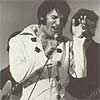 Or as Cheryl Thurber writes of the "Million Dollar Quartet" (Carl Perkins, Jerry Lee Lewis, Johnny Cash & Elvis Presley) -- the recording session at Sam Philips' Sun Studios in Memphis:
. . . When those rising stars of rock 'n' roll sang together the songs they chose to sing were largely gospel songs. It was the shared repertoire that they all knew. They sang other songs as well, such as current rock 'n' roll and recent and older country hits, but they seemed to sing more complete versions of the gospel songs. With gospel songs they knew all the words, not just snatches of the choruses. . . . It is clear when listening to the session that Elvis was the dominant force that day -- he was the one who started the singing of each song. It is also evident that he enjoyed the singing. This was Elvis having fun. 3
Of course, there are many who -- not without reason -- see Elvis Presley as the harbinger of moral decay and the corruption of America's youth. (Fr. Jerry Pokarsky, for example, uses Elvis as a convenient metaphor for the narcissistic character of abuses in the post-Vatican II mass). 4 And by no means should one applaud every star(let)'s excursions into spirituality (I expect Christoph Arnold would have a much different reaction to Madonna's dalliance with watered-down Kabbalah). But for all of his flaws, and the nature of his tragic demise, there is something about Elvis Presley which Christoph Arnold finds praiseworthy:
Here was a unique individual struggling to find his true identity. I am certain that it was through this struggle that God gave him the humor, humility, and kindness that endeared him to millions of people. These traits were even more important than his music . . .Elvis knew his shortcomings. He was an ordinary guy who battled all the normal temptations. But he also had a vision, as expressed in a comment he made to a reporter:
"I ain’t no saint, but I’ve tried never to do anything that would hurt my family or offend God. I figure all any kid needs is hope and the feeling he or she belongs. If I could do or say anything that would give some kid that feeling, I would believe I had contributed something to the world."
In other words, for him, relationships were much more important than the glitter, fame, and money he is mostly known for.
I'll close this little tangent with a quote I found -- from an account of one fan's encounter with Elvis (or rather, a close call with his limo). It may or may not be true, but it's something I can easily envision coming from Presley:
"I know you consider me your king, but I am not worth dying for, there is a bigger King who is God whom you should be preparing yourself for."
2. Gospel Music and Elvis: Inspiration & Consolation, by Helyn Trickey. CNN.com. August 26, 2002.
3. Elvis & Gospel Music, by Cheryl Thurber. REJOICE! The Gospel Music Magazine. (1988).
4. Elvis Sightings in the Roman Rite, Catholic World Report January 2002.
Friday, August 03, 2007
"In Praise of Tap Water"
Here are the hard, dry facts: Yes, drinking water is a good thing, far better than buying soft drinks, or liquid candy, as nutritionists like to call it. And almost all municipal water in America is so good that nobody needs to import a single bottle from Italy or France or the Fiji Islands. Meanwhile, if you choose to get your recommended eight glasses a day from bottled water, you could spend up to $1,400 annually. The same amount of tap water would cost about 49 cents.Next, there’s the environment. Water bottles, like other containers, are made from natural gas and petroleum. The Earth Policy Institute in Washington has estimated that it takes about 1.5 million barrels of oil to make the water bottles Americans use each year. That could fuel 100,000 cars a year instead. And, only about 23 percent of those bottles are recycled, in part because water bottles are often not included in local redemption plans that accept beer and soda cans. Add in the substantial amount of fuel used in transporting water, which is extremely heavy, and the impact on the environment is anything but refreshing.
Tap water may now be the equal of bottled water, but that could change. The more the wealthy opt out of drinking tap water, the less political support there will be for investing in maintaining America’s public water supply. That would be a serious loss. Access to cheap, clean water is basic to the nation’s health.
From In Praise of Tap Water New York Times Editorial. (Hat tip Bill Cork. I got no problem with tap water.
Friday, July 06, 2007
Life Explained
On the first day, God created the dog and said:"Sit all day by the door of your house and bark at anyone who comes in or walks past. For this, I will give you a life span of twenty years."
The dog said: "That's a long time to be barking. How about only ten years and I'll give you back the other ten?"
So God agreed.
On the second day, God created the monkey and said:
"Entertain people, do tricks, and make them laugh. For this, I'll give you a twenty-year life span."
The monkey said: "Monkey tricks for twenty years? That's a pretty long time to perform. How about I give you back ten like the dog did?"
And God agreed.
On the third day, God created the cow and said:
"You must go into the field with the farmer all day long and suffer under the sun, have calves and give milk to support the farmer's family. For this, I will give you a life span of sixty Years."
The cow said: "That's kind of a tough life you want me to live for sixty years. How about twenty and I'll give back the other forty?" And God agreed again.
On the fourth day, God created man and said:
"Eat, sleep, play, marry and enjoy your life. For this, I'll give you twenty years."
But man said: "Only twenty years? Could you possibly give me my twenty, the forty the cow gave back, the ten the monkey gave back, and the ten the dog gave back; that makes eighty, okay?"
"Okay," said God, "You asked for it."
So that is why for our first twenty years we eat, sleep, play and enjoy ourselves. For the next forty years we slave in the sun to support our family. For the next ten years we do monkey tricks to entertain the grandchildren. And for the last ten years we sit on the front porch and bark at everyone.
Monday, April 30, 2007
Saturday, January 27, 2007
Monday, January 01, 2007
Evan Thomas could give DeNiro some pointers on making a good espionage film
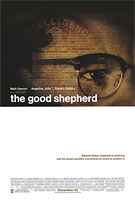 I saw The Good Shepherd over the holiday weekend. Directed by Robert DeNiro, starring Matt Damon and Angelina Jolie, it purports to be "the untold story of the birth of the CIA." Regretfully, it fails to deliver.
The plot is laid out across some notable events in the history of the Central Intelligence Agency -- it's origins in the OSS (Office of Strategic Services) struggling to roll back the Soviet tide in World War II, in anticipation of Stalin's bid for power, it's later operations in Central America and the Bay of Pigs fiasco, tied together from the perspective of a fictional character named Edwin Wilson (an amalgam of James Jesus Angleton and Richard Bissell). Failing to heed the advice of his mentor ("Get out while you still can, while you still have a soul"), Wilson's gradual moral corruption in the in the clandestine world of espionage and U.S. foreign policy is a window into the soul of our nation. "The Godfather Part II set in Langley, Virginia" as one reviewer put it.
While I am generally unapposed to the use of fictional characters when making a historical film, I wonder if, in this particular case, DeNiro couldn't have done better to forego the soap-opera and emphasize the history -- and even confine his gaze on a small part of that history for that matter. Covering three decades of U.S. covert operations and espionage would have been better accomplished in the form of a documentary series on PBS television. As a sprawling two hour and 46 minute Hollywood epic, one gets the sense that the scriptwriter (Eric Roch - Munich 2005) bit off a little more than he could chew. As Wesley Morris notes:
Indeed, "The Good Shepherd" is chock full of everything -- assassinations, betrayal, comeuppance, marital discord, the rise of Castro, an intense torture sequence, defenestration, John Turturro as a sociopath agent, De Niro "Strangelove"-ing it up in that wheelchair, the brief return of Joe Pesci as an informant, and a manmade plague of locusts.In short, the film fails in its effort to be "all things to all people". Buried within are the makings of what would have been a truly great "cloak and dagger" film (Wilson's sparring with his KGB nemesis Ulysses), or even a decent chronicle of U.S. covert operations, but in the end, I found myself more annoyed than anything else -- suffering through the dreary soap-opera of the protagonist's life and anxiously awaiting the occasional snatches of historical reference that filtered through. And the fact that the main characters in the the film are works of fiction, their relation to the major players in this period of covert history, was for me the greatest aggravation of all. To concur with reviewer William Arnold (The Seattle Post-Intelligencer):But that also leaves it a 2 1/2-hour farrago: a character study, a soap opera, a psychological profile, and a docudrama full of Roth's obvious affinity for cool spy jargon ("The doctor has no more patients," says Hurt to Damon about a CIA-backed coup in Cuba).
[DeNiro] can't begin to tie the movie's sprawling events into a satisfying narrative package. It seems not only aimless, but redundant, choppy and unnecessarily confusing. . . . his characterizations are clumsy, and his members of the Power Elite always seem less real people than stick figures in a propaganda movie.
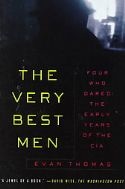 DeNiro's interpretation of the CIA's history is tainted with a strong dose of liberal spin which I imagine will appeal to the Howard Zinn school of history. If readers desire something a little more substantial, they would be better served putting their $10 towards purchasing Evan Thomas' engrossing The Very Best Men: The Daring Early Years of the CIA Simon & Schuster (October 17, 2006: 2nd Edition), which asks the same moral questions and covers much of the same historical ground as The Good Shepherd.
Whereas DeNiro attempts to blend history and Hollywood fiction, a drama spanning three decades interspersed with allusions to historical events, Thomas covers the actual lives of four pioneers of the CIA: Frank Wisner, Richard Bissel, Tracy Barnes and Desmond Fitzgerald: principled men with strong convictions and laudable goals (stemming the Communist tide), yet deeply flawed in its execution. Benefiting from extensive interviews, Thomas' book portrays the CIA "as it saw itself". One can appreciated the fact that Thomas is both respectful of the general intent of these figures (never dismissing or minimizing the very real concern over the Communist threat), and yet approaching his subject with a critical eye towards the moral quandaries of their profession.
As Thomas concludes: "In the end, they were too idealistic and too honorable, and were unsuited for the dark and duplicitious life of spying. Their hubris and naivete led them astray, producing both sensational coups and spectacular blunders").
Related Links
- Review: "The Good Shepherd" by Harry Forbes. Catholic News Service Dec. 22, 2006.
- The "Traditionalist" Catholic blog TradReviews has seen The Good Shepherd as well. Apparently the blogger appreciated the character development much more than I. Perhaps if I didn't see the film with the expection of a history lesson I would have had a better appreciation for the drama.
- Readers interested in this subject may benefit from J. Ransom Clark's The Literature of Intelligence: A Bibliography of Materials. You can find reviews of the aformentioned book by Thomas here.
- "The Need for Integrity: Thoughts Provoked by The Very Best Men, by Michael Thompson. A "moment of reflection" from the CIA periodical Studies in Intelligence Vol. 39, Number 5, 1996:
[Thomas'] empathy for his subjects--even though an air of amused condescension filters through to an audience when he speaks of his book--points up issues that would otherwise be obscure, as does his vivid evocation of a period when, contrary to the underlying realities of American politics (as we have since learned, sometimes painfully), a dominant Executive, a compliant Congress, a complicit press, a largely unquestioning public, and almost unlimited funds allowed the DDP to function virtually without oversight or accountability.
- "Expert's Picks: Books on Espionage, Selected by Evan Thomas" Washington Post, 31 Jan. 1999
Wednesday, September 06, 2006
"Hottest Substance Known to Man"
On the back wall they had the 'Holy Grail' of spiciness - Blair's 16 Million Reserve:
That's it. The race is over. It's chemically impossible to get any hotter ! Not really a sauce, but worthy of inclusion.What you will find inside the Famous Reserve bottle is amazing, a 1ml pharmaceutical grade vial filled with this Pure Capsaicin Crystal.
Check out The Hot Sauce Blog. The author was brave (crazy? stupid?) enough to add a grain to a bowl of tomato soup, and subsequently made the mistake of giving it to his wife. Read the blog and the comments, and you'll see the testimonies of a few "I can take anything" idiots who've actually tried it straight.
Chile-head that I am, I had my wife take a photo of it, just to say that I saw it. At $275 it was a little over my budget. It's not really something you would use -- more like a collector's item.
I ended up buying another hot sauce -- Blair's MegaDeath -- for my collection -- alleged 550,000 Scoville Units (see link for explanation). They made me sign a disclaimer before purchasing, explaining that after a certain limit they require the disclaimer for legal reasons, citing possible customer misuse of a life-endangering product. (As one commentator noted, after 700,000 SU's you're not really dealing with "sauce" but rather an extract, not intended for direct application).
Here is a list of the hottest sauces known to man.
Sunday, August 27, 2006
The Media Ambulance Hoax
On the night of July 23, 2006, an Israeli aircraft intentionally fired missiles at and struck two Lebanese Red Cross ambulances performing rescue operations, causing huge explosions that injured everyone inside the vehicles. Or so says the global media, including Time magazine, the BBC, the New York Times, the Los Angeles Times and thousands of other outlets around the world. If true, the incident would have been an egregious and indefensible violation of the Geneva Convention, and would constitute a war crime committed by the state of Israel.But there's one problem: It never happened.
-- The Red Cross Ambulance Incident: How the Media Legitimized an Anti-Israel Hoax and Changed the Course of a War zombietime August 23, 2006.
As Neo-Neocon observes:
One of the advantages the blogosphere offers is that--and this is no secret, nor is it a criticism--many bloggers have some form of OCD (obsessive-compulsive disorder). Now, OCD in its milder form isn't necessarily a bad thing. It's only really a problem if it's over the top and out of control, such as the Jack Nicholson role in the movie "As Good As it Gets." But the milder form of OCD merely lends those who demonstrate it an enhanced ability to tend to detail, to persevere and follow through on a line of questioning and research.Read the expose. Judge for yourself. Can we say media bias against Israel?And this tendency, marked in many bloggers, allows them to have uncovered a phenomenal phenomenon, to wit: the number of hoaxes perpetrated both on and by the media. From the debunking of the Rathergate memos to Pallywood to Green Helmet Guy to the present sordid and alarming story, the Red Cross Ambulance Hoax, it took the time and perspicacity available to bloggers to uncover some exceptionally disturbing--and historically influential--trends.
Sunday, July 23, 2006
"Jump to Prevent Global Warming"
[on July 20] "Earth occupies one of the most fragile positions in its orbits for the last 100 years." According to the site, the shift in orbit will "stop global warming, extend daytime hours and create a more homogeneous climate."The site and project -- but of course -- is a a joke, but nevertheless managed to garner the estimated participation of 600,248.012 "registered jumpers."
Link by Shawn at Everything I Know Is Wrong.
Wednesday, July 19, 2006
The War Against Israel - News and Commentary Part II
- The political cartoonist duo John Cox and Allen Forkum (popularly known as "Cox & Farkum") published a cartoon depicting the "disporportionate response" toward Israel, including a depiction of the Pope which provokes intense discussion by Amy Welborn's Open Book. Most Catholic bloggers happen to agree agree on the tastelessness of the cartoon ("Portraying the Holy Father using the tip of his crozier as a spear - inflicting injury on a bound, prostrate Jew is malignant") but, as expected, disagree with each other over the justness of the Vatican -- or, rather, Cardinal Sodano's -- pronouncement on the matter. Protests Christopher Fotos:
Multiple statements of grave concern do not, with all sincerely due respect, protect Israel from terrorism. The bitter experience of Israel is that after they withdraw from contested areas, whether under international blessing as from Lebanon or unilaterally from Gaza, these areas are then used as operating areas to launch more terror attacks. I don't expect the Catholic Church to advocate for war. I hope it is not too much to expect some kind of recognition that Israel faces an existential threat.
- HonestReporting.com provides Israel Under Fire: "A look at some of the myths and facts following Hezbollah's attack on Israel" July 16, 2006; MEMRI (Middle East Research Institute) has a 5-part (to date) series chronicling Iran and the Recent Escalation on Israel's Borders: Reactions in Iran, Lebanon, and Syria
 IDF enters Lebanon: A New Buffer Zone? - Bill Roggio examines Israel's intent in the IDF's brief entrances into Lebanon "to target Hizbullah bases along the border in order to push the terrorist group out of rocket-firing range" (Jerusalem Post); included is a disturbing graphic by Kathryn Cramer depicting the extent to which Israel falls within the sights of Iranian built missiles possibily in Hezbollah's arsenal.
 According to London-based, Saudi-owned newspaper Asharq Al-Awsat, "Teheran has supplied Hezbollah with approximately 11,500 missiles and projectiles" and "more than 3,000 Hezbollah members have undergone training in Iran." In The Israeli Rocket Blitz (Winds of Change July 17, 2006), we learn that "more than 70 percent of Israel's population and 80 percent of the country's idustrial base within Katyusha [rocket] range from hostile borders."
Substantial analysis of Israel's incursion into Lebanon by Daveed Gartenstein-Ross (with help from counterterrorism consultant Daniel Darling) is available from the CounterTerrorism Blog.
- The Israeli blogger Kishkushim provides real-time updates from Haifa, including the following observation on the nature of civilian casualties in the present conflict:
So many civilians are dying because this war is being conducted against an enemy who launches missiles from the safety of non-combatant population centers at Israeli cities, towns, and villages with the explicit goal of harming civilians. As much as the equivocators will try to deny this, the IDF does not aim to kill non-combatants. Even if you want to believe that the Israeli army is morally indifferent, you have to concede that civilian deaths cause tremendous harm to the reputation of the country and its ability to operate in the international arena. It is against the IDF's own strategic interests to harm civilians.
- Kishkushim's point is perhaps validated by the diary of this IDF pilot participating in the raids on Lebanon:
Major E, my formation leader walks into the briefing room, still in his jeans. He's been called to come ASAP. What's happening? He asks me. I update him, and we brief for our mission quickly. He is concerned about making mistakes, and bombing the wrong targets. He is experienced, and has been around long enough to see mistakes happen and innocent civilians killed. A friend of his, a helicopter pilot once mistook a letter in a target's name, and ended up shooting at the wrong target, killing a whole family. Major E does not want the same thing to happen to us. He emphasizes that there is no rush, that we must check and recheck every coordinate we receive, make sure we understand EXACTLY what we are supposed to target.
We land in the base, and are relieved to learn that we went for a Hizbullah post. Probably unmanned. It's strange how the focus in these missions is not to succeed, hit the target precisely, but rather - not to make any mistakes. The message is clear all the way from the Squadron commander to the last pilot. One mistake can jeopardize the whole war, like in Kfar-Kana, in one of the last operations in Lebanon, where artillery bombarded a refugee camp, killing over 100 people, which resulted in international pressure that halted the operation. Hitting the target is expected, no misses are acceptable. There aren't any congratulations for a well-performed mission. Only a hammer on the head if something goes wrong. Personally, I think it's a healthy attitude; it causes the whole system to be less rash and hot on the trigger.
- Meanwhile, there is a report from the IDF that Hizbullah preventing civilians from leaving villages in southern Lebanon:
Roadblocks have been set up outside some of the villages to prevent residents from leaving, while in other villages Hizbullah is preventing UN representatives from entering, who are trying to help residents leave. In two villages, exchanges of fire between residents and Hizbullah have broken out. (Hanan Greenberg)
- It has likewise been reported that Hezbollah is deliberately targeting civilians with missiles containing ball-bearings. According to the (by no means conservative) organization Human Rights Watch:
Hezbollah's attacks in Israel on Sunday and Monday were at best indiscriminate attacks in civilian areas, at worst the deliberate targeting of civilians. Either way, they were serious violations of international humanitarian law and probable war crimes, Human Rights Watch said today. In addition, the warheads used suggest a desire to maximize harm to civilians. Some of the rockets launched against Haifa over the past two days contained hundreds of metal ball bearings that are of limited use against military targets but cause great harm to civilians and civilian property. The ball bearings lodge in the body and cause serious harm
(Lebanon: Hezbollah Rocket Attacks on Haifa Designed to Kill Civilians Human Rights Watch July 18, 2006).Michael Kraft at Counterterrorismblog comments:
The story was unusual in that it was one of the few that have reported that the terrorist groups attacking Israelis are not using only explosives but also pieces of metal intended to deliberately cause pain and suffering to victims who are not killed outright. The Hamas makers of the suicide bomb belts routinely pack the bombs with nuts and bolts and nails. There also have been reports that the metal fragments are sometimes dipped into a pesticide, in order to maximize the damage to the victims and make it more difficult for doctors to effectively treat their patients. However there has been little public reporting in the western media of this tactic, which causes torture to the victims who survive the original blast and additional agony for their families and friends.
- Just War for the Sake of Argument - UCLA Law Professor and Catholic blogger Stephen Bainbridge addressese Cardinal Sodano's criticism that "Israel's right to self-defense "does not exempt it from respecting the norms of international law, especially as regards the protection of civilian populations," the rebuttal of fellow blogger (and Catholic) Ed Morrisey (of the popular conservative blog Captain's Quarters) and Israel's strategy of targeting the Lebanese civilian instructure which supports Hezbollah:
In fact, however, Israel clearly is targeting not just Hezbollah, but also Lebanon's official military, and, most important for our purposes, Lebanon's basic civilian infrastructure. The Beirut airport has been closed by Israeli attacks. Bridges, ports, roads, and power stations are all being targeted. As this column was being written, more than 100 civilian fatalities -- including some citizens of neutral countries, most notably Canada -- already had been reported. More surely will have occurred before this column is published.
Rob Driscoll at The Remedy responds to Prof. Bainbridge on Proportionality in War:In short, even a just war must be waged justly. Israel is entitled to defend itself, but is not entitled to do so disproportionately or to wage war on civilians. Yet, that is precisely what Israel appears to be on the brink of doing.
I'm hardly convinced that Israel's attacks are disproportionate. When fighting an enemy that consciously blends civilians and military actors in order to disguise themselves and use civilians as human shields, the death of innocents is inevitable. How is it, asks Wretchard, that those who use indiscriminate bombing of civilian targets are considered to have the moral high ground over those who use precision strikes to minimize civilian deaths?
Further, it is not clear to me that attacking infrastructure is per se disproportionate. Roads and fuel depots are as easily used for rocket attacks on Israeli cities as they are for legitimate civilian ends. If the infrastructure is not a legitimate target, and precision strikes aimed at terrorists who hide amongst women and children are not acceptable, just what may the Israeli military do without violating just war doctrine?
- In Israel, Right or Wrong? Fr. Martin Fox, pastor of St. Mary and St. Boniface Parishes in Piqua, Ohio, expresses his thoughts on Lebanon's culpability and complicity in Hezbollah's attacks on Israel, the proportionality of Israel's response, and the Vatican's statement on the matter. There are no easy answers to such questions, but I certainly agree with his conclusion:
. . . I think it's abundantly clear Israel operates far more according to values of compassion and human dignity; and who can say that about Hamas, Hizbollah, Iran or Syria, with a straight face?
- Finally, Judith Sudilovsky of the Catholic News Service reports that U.S. Catholic educators in Israel say rockets give them new outlook (July 18, 2006):
Some 30 Catholic educators from the United States found themselves in the line of fire in northern Israel as the recent crisis between Israel and Lebanon began, but several said it gave them a new perspective on the Middle East. [. . .] The group was traveling in the north and was to spend the evening of July 14 in Tzfat when word came that Katyusha rockets had fallen on the city . . .
Monday, July 17, 2006
The War Against Israel - News and Commentary
To supplement his post, some further news and commentary culled from the web, which may be of interest to our readers:
- As Israel Goes for Withdrawal, Its Enemies Go Berserk, by David Brooks. New York Times July 16, 2006 (via American Future). David Brooks explains "Why is this Middle East crisis different from all other Middle East crises?":
Because in all other Middle East crises, Israel's main rivals were the P.L.O., Egypt, Iraq and Syria, but in this crisis the main rivals are the jihadists in Hamas, Hezbollah, Syria and, most important, Iran. In all other crises the nutjobs were on the fringes, but now the nutjobs in Hamas and Hezbollah are in governments and lead factions of major parties.
The Weekly Standard's editor William Kristol has a similar take ("It's Our War" Volume 011, Issue 42 ):In all other crises, the Palestinians, thanks to Yasir Arafat's strenuous efforts, owned their own cause, but now the clerics in Iran are taking control of the Palestinian cause and turning it into a weapon in a much larger struggle.
In all other crises there was a negotiation process, a set of plans and some hope of reconciliation. But this crisis is different. Iran doesn't do road maps. The jihadists who are driving this crisis don't do reconciliation.
In other words, this crisis is a return to the elemental conflict between Israel and those who seek to destroy it. And you can kiss goodbye, at least for the time being, to some of the features of the recent crises. . . .
. . . it's not an Arab-Israeli war. Most of Israel's traditional Arab enemies have checked out of the current conflict. The governments of Egypt, Jordan, Iraq, and Saudi Arabia are, to say the least, indifferent to the fate of Hamas and Hezbollah. The Palestine Liberation Organization (Fatah) isn't a player. The prime mover behind the terrorist groups who have started this war is a non-Arab state, Iran, which wasn't involved in any of Israel's previous wars.
What's happening in the Middle East, then, isn't just another chapter in the Arab-Israeli conflict. What's happening is an Islamist-Israeli war.
- The Rogues Strike Back: Iran, Syria, Hamas, and Hezbollah vs. Israel, by Robert Satloff. Weekly Standard 07/24/2006, Volume 011, Issue 42:
Iran thumbs its nose at Western diplomats and continues nuclear enrichment. Hamas's chief, speaking from Damascus, boasts about kidnapping an Israeli soldier. Hezbollah launches a cross-border raid, prompting Israeli retaliation in Beirut and a return volley of rockets on northern Israel. Just another bleak week in the hopeless Middle East? Regrettably, no. This one was different. This was the week the Dark Side went on the offensive.
- On the Middle East - Amy Welborn's blog hosts a mostly-civil discussion of the formal response of the Vatican, controversy sparked by Cardinal Secretary of State Angelo Sodano's condemnation of "the attack on Lebanon, a free and sovereign nation." (A nation which happens to host a vicious terrorist organization -- as one reader comments: "'Lebanon' is a fiction, not a sovereign state. It is a playpen for Hezbollah").
Domenico Bettinelli offers further analysis of the Vatican's statement: "I haven’t been shy about criticizing certain Vatican diplomats’ past embraces of Palestinian terrorists at the expense of Israel, but I think the criticism may be a bit unwarranted here."
- The loss of self, by Josh Tevino. Enchiridion Militis July 16, 2006:
Deutsche Welle has an interesting little roundup of European press reaction to Israel’s campaign against Hezbollah, most of which appears to condemn the Israeli actions as “disproportionate.” As a corollary, Spanish Prime Minister Jose Luis Rodriguez Zapatero (of Spanish Flee fame) went on record stating that the results of the Israeli response to the agents of radicalization, fanaticism, conflict and instability will be “radicalization, fanaticism, conflict and instability.” The European reaction is instructive for several reasons: First, because it is indicative of the extent to which nationalism and national feeling has declined — there is simply little understanding of why a state would seek so dramatically to protect its own. Second, because it illustrates the European mindset on Islamism — that it is indestructible, and by implication, that its agents cannot be repelled or thwarted. Third, because it lets us know, again, that the Europeans do not see Israel as one of its own — even though, in the cultural and historical sense, it is — and that they blame Israel in a manner reminiscent of those who would blame a provocatively-dressed woman for her rape.
European received wisdom is wrong on all counts.
- War By Proxy In Lebanon, by Mark Gordon. Suicide of the West July 14, 2006:
The world demanded that Israel leave Lebanon, so in 2000 it did. The world demanded that Israel leave Gaza, so in 2005 it did. Rather than planting date trees, Lebanese extremists turned their country into an outpost of Iranian and Syrian aggression. Rather than plant olive trees, the Palestinians in Gaza planted mortar tubes in the soil and strapped suicide belts on their children. Neither aggression against Israel - Lebanese or Gazan - can possibly be chalked up to Israeli “occupation” because there was no occupation two weeks ago. No, what the present hostilities demonstrate is that the goal of the Islamists - the destruction of Israel - has not changed and cannot change.
- The Left should be supporting Israel in this war - A British socialist makes the case for the Left.
- Regular updates on news and commentary From a pro-Israel perspective -- Jewish Issues Watchdog - "keeping an eye on Jewish affairs - extracting the essential".
- Meanwhile the Situation Worsens Dramatically For Anti-Hezbollah Lebanese, reports Alcibiades @ KesherTalk, with a report by Michael J. Totten, who has close friends in Lebanon.
- LiveBlogging the War and What You Can Do - a compilation of links to Israeli bloggers from J-Blogosphere; TruthLaidBear: MidEastCrisis offers reporting by Jewish, Palestinian and Lebanese bloggers.
For a roundup of news on Iran, see Regime Change Iran: A Daily Briefing on Iran.
So here's an honest question I posed to some friends recently: When does "anti-Zionism" become "anti-Semitism"? The dilemma was provoked when an author at left-wing blog Daily Kos mused Imagine a world without Israel -- which, if you think about it, is more or less the formal policy objective of Hezbollah, Hamas, and other terrorist organizations who would like nothing better than to make that dream a reality.
Hat tip to the conservative-blogging collective Little Green Footballs, who points out that the Daily Kos may be getting their talking points from the "non-profit, non-bias, non-political" -- but decidely pro-Islamic and conspiracy-minded -- Media Monitors Network (MNN): What If Israel Had Never Been Created?, by William Hughes (Tuesday July 11 2006).
Monday, July 03, 2006
Be Here To Love Me: A Film About Townes Van Zandt

"Well, many of the songs, they aren't sad, they're hopeless."
Townes Van Zandt, after being asked why he only wrote sad songs."Aloneness is a state of being, whereas loneliness is a state of feeling. It's like the difference between being broke and being poor." -- Townes Van Zandt
"Townes Van Zandt is the best songwriter in the whole world and I'll stand on Bob Dylan's coffee table in my cowboy boots and say that. -- Steve Earle
Having just seen the documentary Be Here To Love Me: A Film About Townes Van Zandt, I feel like I've just discovered a long-lost musical friend and a man after my own heart. The movie's not quite as good as Dig (still the greatest musical documentary of all time), but it's still a great introduction to a great artist.
Tuesday, June 27, 2006
Bush goes Jogging with Iraqi Amputee (Not the First Time)
WASHINGTON - President Bush took a jog Tuesday with a soldier who lost part of both legs in Iraq, following through on a bedside promise even the president had doubts about at the time.What is interesting is that this is not the first time our President has heeded such an offer. In April 2004, he followed up on a similar promise to U.S. Army Staff Sergeant Michael McNaughton, who lost a leg in Afghanistan:Despite a slight drizzle, Bush and Staff Sgt. Christian Bagge took a slow jog around a spongy track that circles the White House's South Lawn. About halfway through their approximately half-mile run, Bush and Bagge paused briefly for reporters.
"He ran the president into the ground, I might add," Bush said, as the two gripped hands in an emotional, lengthy shake. "But I'm proud of you. I'm proud of your strength, proud of your character."
In the months since his wounding, Sgt. McNaughton has undergone at least 11 separate operations as a result of his injuries and has been fitted with a thin, robotic prosthetic shaft to replace his right leg. While recuperating at Walter Reed, Sgt. McNaughton was honored to receive a visit from President Bush. One of the subjects of common interest they discussed was running, and the President extended an invitation to Sgt. McNaughton to come running with him once he was up and about.("Born to Run" Snopes.com).The President's invitation posed something of a dilemma for Sgt. McNaughton: "He said give him a call and we'll go running. How are you supposed to just call the president?" Fortunately, Sgt. McNaughton's doctor at Walter Reed was also a doctor for the President, and the two men were able to keep in touch through her.
In April 2004, Sgt. McNaughton and his family made the trip to Washington, and — true to his word — the President went for a run with him.
Saturday, June 17, 2006
Great Moments in the History of Pacifism
"I would like you to lay down the arms you have as being useless for saving you or humanity. You will invite Herr Hitler and Signor Mussolini to take what they want of the countries you call your possessions..."If these gentlemen choose to occupy your homes you will vacate them. If they do not give you free passage out, you will allow yourselves, man, woman and child to be slaughtered, but you will refuse to owe allegiance to them."
Monday, June 12, 2006
Men are not corrupted by the exercise of power or debased by the habit of obedience, but by the exercise of a power which they believe to be illegitimate, and by obedience to a rule which they consider to be usurped and oppressive.-- Alexis De Tocqueville: Introduction - Democracy in America
