Monday, March 27, 2006

Thomas Blosser - "Uncle Tom" - Memories and Request for Prayer

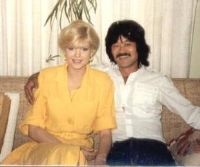
I only have distant (but very fond) memories of my uncle -- He was Japanese, adopted by birth, but in many ways more American than my father, having imbibed Western culture to the fullest, marrying a bluegrass banjo legend from Alabama named Wendy Holcombe (he played bass guitar, although I don't know the precise circumstances of their meeting). I remember the first time we met Uncle Tom and Aunt Wendy in Knoxville -- they treated my brother Jon and me to pizza at Chucky Cheese, and a Walt Disney movie (The Black Cauldron).

Later on they came to Hickory, NC, where they stayed for a brief spell, and Aunt Wendy played banjo in our living room, including "Foggy Mountain Breakdown" (theme from Bonnie & Clyde).

There was a legend going around that a bunch of silver dollars were buried in the dirt-floor basement of the house we lived in at the time. I remember Uncle Tom actually rented a metal detector and spent the afternoon excavating with a shovel, to no avail. He was crazy and full of fun. He also helped my brothers and me rake leaves in the backyard (a never-ending chore during the fall).

Funny the little things you remember.

Aunt Wendy died very young, a victim of a heart ailment, and Uncle Tom never fully recovered in his grief. He had fallen out of touch with the rest of the Blossers, eluding my father's efforts to locate him.

This past Friday, my father got a call from my grandfather, who was just informed by somebody in Birmingham, Alabama, that my Uncle Tom had passed away.

We had always entertained the faint hope of seeing Uncle Tom again, so this is especially hard news to take.

Please keep Thomas Blosser in your prayers, as well as my father and the rest of our extended family.

  • The Adoption of Our Son Thomas, from the collected memoirs of Eugene and Louella Gingerich Blosser.
  • Thomas Blosser (1951-2006), RIP - Dr. Blosser, March 29, 2006.
  • Thomas Yoshiro Blosser - In Memoriam The obituary in The Birmingham News gave only the following spare details for Thomas Yoshiro Blosser the following Monday morning:
    BLOSSER, THOMAS YOSHIRO, Accomplished local musician, Thomas Yoshiro Blosser, died suddenly of natural causes on Thursday, March 23, 2006. Born November 3, 1951, in Muroran, Japan, he became a naturalized US Citizen, was married to the late Wendy Holcombe, and is survived by his adoptive father, Eugene, and siblings, Philip, Rachel and Meiko. Memorial Services will be held on Monday at 2:00 p.m. at Charter Funeral Home, 621-0800. Published in The Birmingham News on 3/27/2006.
    These few sentences, of course, do not begin to fathom the story of Tom's life; nor can I, for that matter, in the brief compass of this post. But the story begins long ago in Japan. Read the rest of the story here.

Thursday, January 26, 2006

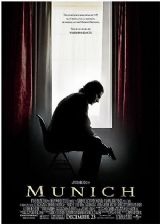
Reflections on Steven Spielberg's Munich

At 5:00 AM, September 5th, 1972, a seminal event in the development of modern terrorism took place. Eight Palestinian terrorists invaded the site of the Olympic Games in Munich, Germany. They killed and took hostage eleven Israeli athletes competing in the Games, demanding the release of over 200 imprisoned Arabs and 2 German terrorists. Over the next few tension-filled days, all the hostages and some of the terrorists were killed, and the remaining terrorists escaped, mostly due to incompetence and perfidy of the German government. The Olympic Committee made a controversial decision to continue the Games, and has never held any memorial for the slain athletes. Eventually almost all of the remaining terrorists were hunted down and killed by Israeli agents, directed by then Prime Minister Golda Meir.

-- Munich Remembered, by Judith @ Kesher Talk.

The authoritative documentary of the Munich Massacre is One Day in September.

The new Steven Spielberg film Munich, loosely based on George Jonas' book Vengeance, purports to be "the story of what happens next," following the 1972 Munich Massacre. Many critics and pundits (predominantly those on the left) have praised it as a stirring commentary on the Israeli-Palestinian conflict and its "cycle of violence", as well as a cinematic protest against the Bush administration's "war on terrorism."

Munich: Praise

Discussing The Morality of 'Munich' Alternet Dec. 24, 2005), Jordan Elgrably heralds Munich as "the work of a mature filmmaker--one who does not appear beholden to popular American Jewish opinion that Israel is always the underdog," with a timely moral lesson for today's conflict:

The military occupation of Palestinian territories is in its 38th year; the settlement movement continues apace; and all the international peace initiatives have failed. The one dependable reality of the conflict -- Palestinian suicide bombings and Israeli targeted assassinations -- is utterly bankrupt. Nothing remains but for the Palestinians to seek justice with a nonviolent revolution for peace, in the spirit of Mahatma Gandhi, and for the Israeli people to follow new leaders who can devise political rather than military solutions.

Andrew Gumbel applauds Munich's implicit criticism of President Bush: (The Independent January 5, 2006):

The material not only takes a sideswipe at Israel and its long-standing policy of doing whatever it takes to guarantee its own survival. The parallels with George Bush's America are also unmistakable, at a time when the moral standing of the United States around the world has been severely undermined by reports of torture, targeted killings and war justified by intelligence that was either incorrect or deliberately skewed to suit a pre-determined political agenda. To ensure that the point is not missed, the film concludes with a shot of the lower Manhattan skyline including the now-fallen twin towers of the World Trade Center.
David DiCerto of the USCCB's (Conference of Catholic Bishops) Office for Film & Broadcasting praises Munich as "a clear statement by the filmmaker that violence comes at a cost of one's soul," a continuation of "a cinematic conversation about the value of human life begun with Schindler's List. The message of that film was that 'whoever saves one life, saves the world entire.' The grim counterpoint here suggests that in taking lives the light of our humanity is collectively dimmed."

And JB (aka Dawnwatchman explicates Munich's gospel of nonviolence:

Munich speaks extensively about home, brotherhood, morals, and achieving peace on earth. However, these themes are secondary to the point Spielberg is trying to make through a powerful meditation. The dogma of an eye for an eye does not work. Here is where the irony comes into play, for the solution is most likely beyond what Spielberg intended. For we know that only the New Law is capable of justifying a man in the sight of God. Therefore, the problems and conflicts in the Middle East can’t be arbitrated using a precept of the Old Law. The New Law alone is sufficient. What this means is something which neither side is willing to accept. Israelis and Palestinians need to learn to live together. To break bread together, so to speak. It’s either that or somebody has to relocate to another part of the world, either of this life or the next. In better words, the Old Law must pass away:

“You have heard that it hath been said: An eye for an eye, and a tooth for a tooth. But I say to you not to resist evil: but if one strike thee on thy right cheek, turn to him also the other.” – Matt., 5:38-39

Munich: Criticism

On the other hand, other critics have charged that the very zealousness with which Spielberg condemns the Israeli-Palestinian conflict has led him to entertain the notion of "moral equivalence" -- namely, that there is, with a view to the consequences, no ultimate difference between the Palestinian terrorist and the Israeli soldier.

Captain's Quaters, for instance, gave a disappointing review of the film:

On its most facile level, Munich is a gripping film. Had it been based on complete fiction -- if Spielberg had had the sense to manufacture a hypothetical instead of hijacking history and twisting it -- then it might have even had a valid point to make. Spielberg has lost nothing as a film director in a technical sense, . . . The cinematography, music, mood, and all of the technical efforts put into the film are first rate, without a doubt.

And every last bit of it gets wasted by a silly sense of moral equivalency that comes from a fundamental misrepresentation of the threat Israel faces, and in the strongly suggested allegorical sense, the threat that faces the US and the West now.

The problem with Munich, says the author, is that "by equating the two sides, Spielberg and the world gave the perpetrators of terrorism the same moral standing as its victims, especially when the victims sought to ensure that their enemies could not live long enough to plan more such attacks."

Cliff Kincaid and Roger Aronoff of Accuracy in the Media describe the film in terms of a Hollywood Surrender to Terrorists:

It is apparent that the movie is not only supposed to be historical but meant to send a message to Israel, the U.S. and the Bush Administration. The film's website even says that "the film takes audiences into a hidden moment in history that resonates with many of the same emotions in our lives today." Spielberg intends to convince us that responding to terrorism with military force is hopeless. . . .

The real problem with the film is the moral equivalence, as Spielberg talks about "intransigence" and complains about "response to a response," as if Israel is at fault for trying to defend itself. What he seems to forget is that Israel is fighting for its very existence against an Arab/Muslim bloc of nations that still preaches hatred and destruction of Jews and Israelis.

Roger Ebert, who gave the film a big thumbs up, says about Spielberg's approach: "By not taking sides, he has taken both sides." But how can that be morally correct or defensible?

FrontPageMag also hosted a (sometimes heated) Symposium on Munich, inviting several authors and commentators -- pro and con -- to discuss the meaning of the film. Carl Horowitz points out that Munich mastermind Mohammed Daoud has voiced his disagreement with the film's depiction of his team, charging: "We did not target Israeli civilians. Some of the athletes had taken part in wars and killed many Palestinians. Whether a pianist or an athlete, any Israeli is a soldier." According to Horowitz, Doud's "factually-challenged rant performs a useful function. For it indicates that Spielberg would have had to have gone a lot further to appease his Arab critics – that is, to make a film that truly was morally equivalent."

Arnold Steinberg disagrees:

This movie is an assault on the war on terrorism. That's why the movie ends with the twin towers in the background. It's supposed to bring you full circle, on the cycle of violence b.s. which is the corollary of moral equivalence, alongside the Arabist belief that the U.S. provoked 9-11.

This movie clearly implies the Israeli response to Munich escalated, if not unleashed, a new generation of terrorism that culminated in 9-11. Kushner cleverly projected plausible even-handedness, but on the points that mattered, he gutted Israel. Remember, the Palestinian wins the homeland debate by default. I talk mainly about Kushner, because he used Spielberg, who has much more clout. . . . Munich was dishonest, overwhelmingly so, factually. Moreover, the mission, to the extent it existed, was not revenge, but to disrupt the terrorist hierarchy, which it did. And to quote Daoud attacking Spielberg? Bottom line -- this movie depicts the straight Arabist line -- this is a real estate conflict and ignores the reality that key Arab constituencies, from religious zealous to secular extremists, hate Jews and want them dead.

In Spielberg’s Moral Confusion (NRO, Jan. 6, 2006), Monica Charen criticizes Spielberg's inattention to history and the impact it will likely have on its audience, some of whom weren't even alive in 1972 (like myself, I admit) and probably won't bother investigating the actual facts of the incident:

Munich is a well-crafted movie, but it is a deeply and disturbingly dishonest one. Many moviegoers were not even born in 1972, and many who were alive will scarcely remember the details. Do moviemakers owe nothing to them? Do they owe nothing to the truth? This is not Oliver Stone’s JFK, but for that reason its effect may be more insidious. The film looks like history but it is a morality play of the artist’s imagination. Spielberg uses real historical figures like Golda Meir as props, putting words in their mouths that they not only did not say, but would never have said. During the opening credits, the audience is informed that the film is “inspired by real events.” That could mean anything — but movie audiences probably will not parse the words with lawyerly care. They will read it in the context of a film that offers generous servings of verisimilitude. There are clips of sportscaster Jim McKay reporting from the Munich Olympics in 1972, as well as the voice of Peter Jennings narrating the harrowing events. Some of the details of the kidnapping and murder of the eleven Israeli athletes are well-researched. But as CC Colton warned, “Falsehood is never so successful as when she baits her hook with truth.”

Credible Witness? -- Rinker Buck, George Jonas and Yuval Aviv
To compound the problem, Monica Charen notes that the very book Tony Kushner allegedly based his script on -- George Jonas' Vengeance: The True Story of an Israeli Counter-Terrorist Team -- is itself highly questionable:

Jonas based his tale on the word of one Israeli who claimed to have headed a clandestine assassination squad for the Mossad. But Jonas was the second, not the first author to whom this particular Israeli had peddled this tale of “Avner,” the Israeli hit man. The first, according to Time, was a writer named Rinker Buck who was offered an advance from Simon and Schuster. But the deal fizzled when Buck traveled to Europe to check his informant’s information and found that “he was changing his story daily.” Buck said he could not write the book in good conscience. Jonas apparently could. And while the book has been debunked for 20 years, Spielberg saw fit to build a movie upon it.
  • For background on Rinker Buck's conscientious refusal to peddle Avner's story, see "Believing What You Read", by Thomas Griffith Time June 25, 1984).

  • More on Jonas' book from Bret Stevens (Munich: What's wrong with Steven Spielberg's new movie Wall Street Journal Jan. 1, 2006): "Yuval Aviv, who claimed to be the model for Avner . . . was, according to Israeli sources, never in the Mossad and had no experience in intelligence beyond working as a screener for El Al, the Israeli airline."

  • For background on Yuval Aviv himself, see Spielberg could be on the wrong track, by Yosi Mellman Ha'aretz Jan. 8, 2006:
    The problem arose five years later, in 1989, when a third party claimed in a lawsuit that private investigator Yuval Aviv, an Israeli, was Canadian journalist George Jonas' source. In the lawsuit, Jonas identified Aviv as a key figure in the book and argued that Aviv had dishonored an agreement and prevented him from receiving royalties due to him from the profits of the film.

    After this identification, the international press began to publish articles about Aviv. Investigative reports about him revealed that he represented himself as a Mossad agent even though he had never worked in the Mossad and certainly had not participated in operations to kill those involved in the athletes' murder. Aviv, as he emerged from these investigative reports, had a special fondness for conspiracy theories, and it turned out that he was willing to hire out his services to anyone who was willing to pay, even to both sides of the same dispute.

Vengeance author George Jonas himself makes his case for telling "Avner's" story (and the eventual Hollywood cinematization/bastardization) in "the Spielberg massacre" (Macleans Jan. 7, 2006). Jonas stands by his man ("though he was not without a capacity for invention . . . "Avner" described a string of operations of which he had first-hand knowledge") and disavows any relationship with Aviv ("The Israeli newspaper Ha'aretz floats the canard that my source was revealed to be one "Yuval Aviv" in the late 1980s when I sued him in a contract dispute in New York. The fact is, I've never sued anyone in my life, in New York or anyplace else").

At the same time, Jonas notes with clear disapproval Kushner's involvement with the Munich screenplay:

The confirmation that production will definitely be put over until 2005, pending a new script to be written by Tony Kushner, comes only in September. It doesn't come from Mendel. It comes from "Avner" who appears to be very much in the loop -- and thoroughly besotted. A spook in the grip of celebrity worship is a sight to behold.

"Avner" writes that with the new script Spielberg is planning "in some aspects to stay parallel with the book. But of course he [takes] the book where only Steven can take it." Considering Kushner's stance on Israel, it isn't hard to imagine where that will be. In addition to his magnum opus, Angels in America: A Gay Fantasia on National Themes, Spielberg's new screenwriter is co-author (with Alisa Solomon) of a 2003 book, Wrestling With Zion: Progressive Jewish-American Responses to the Israeli-Palestinian Conflict. The title forecasts a film that will be a "progressive" Jewish-American response to the Munich massacre. No wonder there's a reluctance to let me see the script.

and expresses his disappointment with the finished project by the 'King of Hollywood' himself:
Spielberg's "Munich" follows the letter of my book closely enough. The spirit is almost the opposite. Vengeance holds there is a difference between terrorism and counterterrorism; "Munich" suggests there isn't. The book has no trouble telling an act of war from a war crime; the film finds it difficult. Spielberg's movie worries about the moral trap of resisting terror; my book worries about the moral trap of not resisting it.
Disputing Jonas' account of the operation is Time magazine Israeli correspondent Aaron Klein's newly-published Striking Back: The 1972 Munich Olympics Massacre and Israel's Deadly Response:
A main disagreement between the two books is whether the Mossad's assassinations of the Black September leaders that followed the 1972 Olympic attacks was an emotional reaction against the attackers, as "Vengeance" and "Munich" both assert, or whether, as Klein argues, it was also a strategic response to break up a terrorist network.

"Striking Back" was actually in the works at Random House several years ago, before Spielberg revealed he was working on the film, and wasn't set to come out until next year. Random House rushed publication when it learned of the film's release.

("Rival Tome Snipes at Munich Variety Award Central, Dec. 12, 2005).

Setting the Record Straight
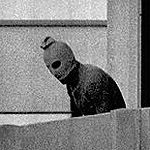
The Jewish blog KesherTalk provides a good roundup of pundit reactions, reviews and blogger commentary on Munich.

Likewise, they do the world a favor by drawing our attention to the historical account of Munich -- the massacre, with a series of reflections on the senseless slaughter of the Israeli athletes:

Parting Thoughts

As one who appreciates Steven Spielberg's previous films (Schindler's List and Saving Private Ryan especially) and his undeniable prowess in moviemaking, I'd certainly like to believe him when he repudiates "blind pacifism," proclaims his fidelity to Israel and defends the making of the film as an exercise in Talmudic questioning (A telephone call with Spielberg, by Roger Ebert. Dec. 25, 2005).

At the same time, having seen the movie myself, I've come to some judgements of my own about the film:

"Humanizing" Terrorism and drawing "Moral Equivalence"

Yes, a certain degree of "humanizing" of the terrorists does occur in the film -- the selected targets are shown in a positive light: a poet reading his translation of 'Arabian Nights' in Italian to a sidewalk audience; a good father with his loving wife and adoring daughter; a good-natured gentleman who offers a cigarette and sleeping pills to Avner before he goes off to bed (and to his death). In reminding us of their humanity, their crimes are practically hidden, their complicity in the deaths of innocents obscured by the veneer of gentleness and charm.

Yet, even in a stairwell encounter between Avner and a Palestinian named Ali, in which the latter is given the opportunity to present his grievances against Israel, I did not feel that Spielberg was putting forth "moral equivalence" in the sense that the direct actions of the terrorists and those of the Israeli strike team were of a piece. Whereas the Palestinians are shown mercilessly slaughtering the Olympic athletes, Avner and his men take scrupulous care not to harm innocent civilians, nearly-aborting one mission where the target's daughter was endangered. Some critics berated Avner's questioning and moral deliberation as a sign of weakness; I'm inclined to agree with Sonny Bunch (Munich Syndrom Weekly Standard Jan. 6, 2006):

. . . Compare this to the Palestinian terrorists who have no problem with turning AK-47s on hogtied hostages. And then there is the deeper question of humanity: Avner understand the justness of his mission, but still struggles with the taking of life. The terrorists show no such qualms.
And yet, I must say there was a great deal in the movie that could -- and did -- lead audiences to conclude a "moral equivalence" with respect to ends: in suggesting that the Israeli's counter-terrorism tactics were themselves a propogator of more terror, and that resorting to armed force for whatever reason inevitably perpetuates a "cycle of violence."

James Bowman, resident scholar at the Ethics and Public Policy Center, lists "a few of the conventional ideas served up by [Spielberg and Kushner]" (Munich: A Review The American Spectator Dec. 30, 2005):

* Revenge is an uncivilized, savage act that lowers the revenger to the level of his victim. As a result, there is always a certain moral equivalence between killer and victim.

* Engaging in revenge perpetuates a cycle of violence.

* Those who are caught up in this cycle and who kill in cold blood often suffer terrible agonies of conscience: nightmares, paranoia, substance abuse, and other manifestations of what we have learned to call post-traumatic stress disorder.

* From governments of all kinds, corruption, violence, and lack of human compassion is to be expected.

* Therefore, one should put loyalty to one's family and friends ahead of loyalty to one's country.

Despite Spielberg's intentions, it seems to me that Munich renders itself easily exploitable by those who are anti-Israel, anti-Bush and anti-war, resisting the very idea that armed force can be used in a morally legitimate manner, in service to the good.

In his reflections on the film -- Art Needs Moral Vision (VictorHansen.com Dec. 27, 2005) -- Bruce Thornton describes the phrase "cycle of violence" as indicative of a modern moral pathology: the inclination to see force "not in moral terms — that is, as the instrument of a righteous or unrighteous choice and aim — but as a reflexive reaction to grievances and wounds to self-esteem." According to Thorton, it is a pathology that has been soundly exploited by Arab terrorists in the defense of their cause:

Jews traumatized by anti-Semitism and the Holocaust drove from their homes Arabs who, in turn traumatized by their suffering and the thwarting of their “nationalist aspirations,” turn to violence, which provokes a response from the Israelis, which creates more suffering, which provokes more violence, and on and on. All we need to do is break the cycle — which usually means getting Israel to stop reacting to Palestinian violence — create a Palestinian state, and the lion will lie down with the lamb.
Thorton himself sees this as the underlying viewpoint of Spielberg's Munich:
In Munich . . . force is viewed with the suspicion typical of the quasi-pacifist liberal. Using force against murderers is futile, the movie keeps telling us, for each dead terrorist is replaced by another one, each killing of a terrorist inspires another act of terrorist retribution. I wonder what would have happened if the same attitude had been taken regarding Nazis or kamikaze pilots. Thank goodness our fathers and grandfathers had more sense. They knew that evil men have to be destroyed, and you stick with the job until the evil men give up or are no more. They knew that evil men choose their evil to advance some aim, and will try to kill you no matter what you do, and are more likely to take heart from a failure to resist than to reconsider their evil aims or to abandon violence. They knew that the sorts of reservations Munich indulges are not signs of a sophisticated sensibility but rather the evasions borne of moral uncertainty, Hamlet-like doubts whose purpose is to avoid action and moral responsibility.

The moral evasions at the heart of Munich evoke another Munich, the Munich of Neville Chamberlain and appeasement, that moment in 1938 when moral exhaustion confronted evil and blinked, unleashing a force of destruction that cost 50 million dead and that was stopped not by understanding of context or empathy with the enemy’s humanity but by righteous force wielded by men who weren’t afraid to call evil by its proper name.

* * *

Munich and the Greater Question of 'Justified Use of Armed Force
I am presently reading The War to Oust Saddam Hussein: The Context, The Debate, The War and the Future (Rowman & Littlefield, 2005), by James Turner Johnson, a notable scholar of military ethics and the just war tradition. Professor Johnson is severely critical of Bishop Wilton Gregory's stance during the Iraq war (and the subsequent position of the USCCB), because its argument against the war began with the prejudice that, in the words of Bishop Gregory, "a moral presumption against the use of armed force." According to Johnson, such reasoning is at a marked variance with the classical just war tradition:

Just war thinking in its classic form is based on something quite different -- a conception of life in political community oriented to a just and peaceful order, in which the use of armed force is a necessary tool to be used by responsibile political authority to protect that just and peaceful order in a world in which serious threats are not only possible but actual. In the presumption against war model, force itself is the moral problem, and peace is defined as the absence of the use of such force. In the just war model rightly understood, injustice and the threat of injustice are the fundamental moral problems, for in the absence of justice, the political community is not rightly ordered, and there is no real peace either in that community or in its relation to other political communities. Force here is not evil in itself; it takes its moral character from who uses it, from the reasons that are used to justify it, and from the intention with which it is used. These are, of course, the classic just war requirements of sovereign authority, just cause, and right intention, and they correspond directly to right order, justice, and peace, the goods at which political community should aim as defined in the Augustinian conception of politics within which just war tradition is soundly rooted. To be sure, force is evil when it is employed to attack the justice and peace of a political order oriented toward these goods, but it is precisely to defend against such evil that the use of force may be good. Just war tradition had to do with defining the possible good use of force, not finding exceptional cases when it is possible to use something inherently evil (force) for the purposes of good.
This post is long enough, so in the interest of time I will refer the reader to James Turner Johnson's excellent essay Just War, As It Was and Is (First Things 149 (January 2005): 14-24); George Weigel also touches upon this briefly in Force of law, law of force (The Catholic Difference April 30, 2003), and at length in his study Tranquillitas Ordinis: The Present Failure and Future Promise of American Catholic Thought on War and Peace Oxford UP, 1987.

I can't help but notice some affinities between those who praise Munich as a cinematic protest against violence (the use of force per se) and those who advocate "a moral presumption against the use of armed force" as the starting point for deliberation in matters of war. I think that a film like Munich might compel Catholics and Christians to evaluate where they stand with respect to this issue:

Is the only response to terrorism the eschewing of violence, the adoption of absolute pacifism?

Is there such a thing as a justifiable and legitimate use of armed force?

Is the 'just war tradition' as it has been developed in Catholic tradition rendered absolete, the opinion put forth by a few voices within the Vatican Curia?

With respect to the last question, I am well aware that then-Cardinal Ratzinger, in a May 2, 2003 interview with Zenit, expressed the opinion that "given the new weapons that make possible destructions that go beyond the combatant groups, today we should be asking ourselves if it is still licit to admit the very existence of a 'just war.'" Some have (incorrectly, I think) imbued this specific line with the full weight of magisterial authority, while others -- like James Turner Johnson -- have questioned its implications, as well as its reasoning.

* * *

Likewise, the question is also raised: in responding to terrorism, what is the appropriate, reasonable and morally justifiable course of action?

Are "targeted assassinations" in the prevention of terrorism acceptable? The Logic of Israel's Targeted Killing, by Gal Luft (Middle East Quarterly Volume X, No. 1, Winter 2003) describes the procedure:

Israelis dislike the term "assassination policy." They would rather use another term—"extrajudicial punishment," "selective targeting," or "long-range hot pursuit"—to describe the pillar of their counterterrorism doctrine. But semantics do not change the fact that since the 1970s, dozens of terrorists have been assassinated by Israel's security forces, and in the two years of the Aqsa intifada, there have been at least eighty additional cases of Israel gunning down or blowing up Palestinian militants involved in the planning and execution of terror attacks.
The legality of Israel's policy is presently being debated in Israeli courts. In a July 2001 State Dept. briefing, the Bush Administration stated that "Israel needs to understand that targeted killings of Palestinians don't end the violence, but are only inflaming an already volatile situation and making it much harder to restore calm." Yet, in a Fox News interview August 2, 2001, Vice President Cheney has also suggested that
"If you've got an organization that has plotted or is plotting some kind of suicide bomber attack, for example, and they have evidence of who it is and where they're located, I think there's some justification in their trying to protect themselves by preempting."
The formal position of the U.S. Government is conveyed in Executive Order 12333, signed by President Ronald Reagan, directing that "no person employed by or acting on behalf of the United States Government shall engage in, or conspire to engage in, assassination." According to the Washington Post, "the original version was signed in 1976 by President Gerald R. Ford in the wake of public disclosure in 1975 that the CIA, with White House support, had attempted assassinations in the 1950s and 1960s of Cuban President Fidel Castro and leaders in the Congo and the Dominican Republic" (Source: Walter Pincus, Washington Post 1998).

However, one can't help but note the "selective targeting" of Al Qaeda members in counter-terrorist operations (the most recent being a Pakistani air-strike which killed two senior members of Al Qaeda and the son-in-law of its No. 2 leader, Ayman al-Zawahiri (New York Times Jan. 19, 2006). How does this differ from the present strategy of Israel?

At this time, Israel is faced with the threat of Iran, a nation that has barely concealed its active seeking nuclear arms, and whose president has stated that Israel should be "wiped off the map," and "God willing, with the force of God behind it, we shall soon experience a world without the United States and Zionism."

Sunday, January 22, 2006

Michael Yon on 'Operation Iraqi Children'

Operation Iraqi Children -- Michael Yon blogs about one of the latest grassroots efforts of the American people to aid the nation of Iraq:
I’ve seen the U.S. Army hold medical screenings, build schools and playgrounds, deliver sporting gear, and so on, but much of the help for Iraqi kids is coming from Joe Citizen, who has never been to Iraq, through a program started when one not-so-ordinary citizen traveled there and saw the immediate need.

While on a USO tour of Iraq in 2003, Gary Sinise recognized the potential as well as the plight of these children. Once back in the United States, he joined forces with a couple of smart and good-hearted people, Laura Hillenbrand and Mary Eisenhower, and took action to address the educational needs of Iraqi kids. In what he describes as “a few breathtaking and exhausting weeks,” these three dynamos organized Operation Iraqi Children (OIC). . . .

A must-read post and a project worth supporting by preparing and sending your own School Supply Kit.

Saturday, January 21, 2006

Abbie Hoffman - Unpublished Interview

In 1986, Kesher Talk contributor Van Wallach interviewed 60s radical Abbie Hoffman for a New York publication. Based on five hours of conversation, the edited transcript never got published. Hoffman died, at his own hand, in 1989. Now, thanks to the magic of blogging, Hoffman's wit and energy live again -- see "Conversations with a Ghost: The Abbie Hoffman Interview".

Saturday, December 31, 2005

Christmas Vacation 2005

  • 12/23/05 - Flight at 9:00am with a nice 3 hour layover in Washington Reagan airport, long enough to grab a pint (Old Dominion ale, quite nice) and a burger and people-watch as the other travelers rushed around. Got into Knoxville, TN around 3:30pm and met Jon. We took a side-trip to his workplace (Toyota) where he showed me his office and the gigantic warehouse where he coordinates the supply of car-parts from Japan and Vietnam to various manufacturers in the state. We hung out at his place for a bit and then hit the town, first the Downtown Grill & Brewery (so-so fajitas, decent beer, great wings) followed by Patrick Sullivan's (founded in 1888), where I proceeded to leave behind a very special (sentimental) Pop Will Eat Itself hat from their '94 tour and my semester in England. Argh!

  • 12/24/05 Woke up and drove to Hickory, NC where we arrived concurrently with Renata and Nathan, fresh back from his Naval tour of the Middle East. In traditional Blosser fashion we presented beloved dad with a fifth of liquor, a six pack and some nice wine for the missus. We got a nice buzz on and spent some time male-bonding on the back porch, target-practice with Nathan's old BB gun.

    Amy's parents came over for dinner -- cheese fondu and a honey-baked ham courtesy of Jon's employers, with some delicious cake for dessert.

    Best of all, I got to see my baby sister Hannah Cabrini for the first time; she's a real cutie, and when she's not screaming she's got an impish grin on her face and a tendency to put anything and everything in her mouth.

    After dinner we opened our Christmas presents -- a set of Iraq's "Most Wanted" Poker Cards from Pa; new fleece sweater from Amy's parents; a blue baseball cap embroidered with J.R.R. Tolkien's "Not All Who Wander Are Lost" from Amy (way cool).

    We played several rounds of poker before/after dinner -- Jon taught me "Texas Hold 'Em" and Nathan a game called "Spit In The Ocean." I don't play all that often, but managed to win $20 in dimes and quarters over the course of the evening, with the loser doing mini-shots of Jim Beam. Unfortunately, Jon did most of the losing and passed out face-first on his old bunkbed in the garage (he slept on the bottom, myself on top) and we had to take off his shoes.

    I had a fitful sleep, partly because I was on the top bunk and from Jon kicking me whenever I started snoring. We learned from Renata that ALL THREE of us were snoring away, poor girl.

  • 12/25/05 . . . and then Pa started blaring Handel's Messiah at six o'clock in the morning. I don't recall this being a Christmas tradition, at least not at such an early hour. Amy's mom had prepared a delicious casserole of eggs, sausage and cheese -- I was tempted to get the recipe but I don't think soy sausage would suffice as an ingredient. We bundled up and went to Mass at St. Aloysius', Hickory where I was confirmed. Saw a lot of familiar faces. The choir was sparse due to the holidays but -- how shall we put this graciously? -- they tried very hard. Afterwards we went to lunch at Amy's parents, where "Grandpa" John showed us his (very impressive) collection of firearms (including World War II era), followed by more presents for Pa and Amy. Christmas evening was pretty low-key as we were all recovering from the night before; we saw The Big Lebowski (a personal favorite of Jon and I). Pa and I got into a minor dispute over the merits of The New Oxford Review, particularly editor Dale Vree's latest hatchet-piece on the neocons (Pa's a longtime fan, I'm really not). I went to bed in the guest room so as to spare Jon and Nathan my snoring.

  • 12/26/05 -- Pa & Amy packed up and left early morning bound for Iowa to see Grandpa & Grandma Blosser. We went out to El Chapala Mexican restaurant (a tried-and-true source of authentic Mexican cuisine -- great margeritas, too) with Nathan and Renata, after which they left for home and Jon and I went shopping for supplies for our camping trip. We cleaned up the house and spent the evening at McGuire's Pub, another Blosser favorite and preferable to the rather pretentious Taproom. We talked politics, relationships and music and I did my best to persuade Jon on the merits of Elvis Presley, the Misfits and (classic) country & western. He'll

  • 12/27/05 - After a brief stop at Outdoor Supply and the old Army-Navy store, Jon and I drove to the Wilson's Creek Wilderness Area, which is known for its many waterfalls. It was cold and the roads were a little icy. The main road leading to our trail was closed, so we were forced to pick an alternative route. We hiked in for .8 of a mile to a campground, where the trail veered off to the right and seemed to fade out -- nobody had been down there in a while, so we thrashed around in the brush a bit before finding out way onto another, longer trail and hiked along the creek a bit to a nice spot where we pitched camp and got a good, roaring fire going. Beef stew (canned) and beer (cheap six pack) for dinner; hot chocolate for dessert. The evening sky was cold, crisp and absolutely clear, making for perfect stargazing before bed. Jon brought a deck of cards and taught me Rummy.

  • 12/28/05 Jon and I woke up around ten o'clock the next morning and after a breakfast of sausage and eggs broke camp and hiked out -- quite the workout for me, as New Yorker that I was, I hadn't been hiking (much less camping) in five years: going in was tough on the knees, coming out hell on the calves . . . all the more incentive to start exercising in the new year. We reached the end around noon, feasted on some fresh tangerines and made our way to Asheville, NC.

    We showered and rested at Mom's apartment for a bit, spent an hour solving a five-star difficulty game of Sudoku that she had printed out for us, and then met her as she got off work at Earth Fare. Had a great Chipotle Chicken Burrito at Mamacita's Mexican Grill washed down with a good pint at Ed Boudreaux's BBQ. Walking around Asheville we ran into old and good friends Lisa Miller and Carrie, both of whom still reside in Hickory and had fled to Asheville for a change of scenery. (If you've ever lived in Hickory, you'll understand that fleeing to Asheville is a frequent and -- for the sake of preserving one's sanity -- necessary pasttime).

  • 12/29/05 Spent the day in Asheville with my mom; breakfast, then laundry, a few used music and book stores, lunch of spicy Thai chicken curry and Basil Noodles at Doc Chey's and a pint of Chocolate Stout at Jack O' The Wood (where I picked up a t-shirt per wife's request).

  • 12/30/05 Quick brunch of pulled pork, sweet fries and macaroni & cheese at Ed Boudreaux's BBQ (had to get in one last good BBQ meal while in the South); then off to Asheville airport for a 2:00pm flight to La Guardia, NYC.

All in all, an excellent vacation. (More photos from Pa here).

P.S. Jon swung by Sullivan's on the way back home and picked up my PWEI hat, so all is well and good in the land of Blosser.

Saturday, December 03, 2005

Maintaining my Status as a Warblogger: The Mother of All Roundups

Various critics (friend and foe alike) have referred to me as a "warblogger" -- a label I find rather curious, since my actual blogging on the war is rather minimal compared to my other interests, and when I do blog, my meager efforts in this regard pale in comparison to the likes of, say, Little Green Footballs or Winds of Change.

When I think of "war blogs," I think of the reporting of combat journalist Michal Yon or blogger Bill Roggio, currently touring Anbar Province, Iraq by invitation of the 2nd Marine Division, or the real 'milbloggers' posting from the trenches.

However, Wikipedia defines a "warblog" as

"A warblog is a weblog devoted mostly or wholly to covering news events concerning an ongoing war. Sometimes the use of the term "warblog" implies that the blog concerned has a pro-war slant."
So on that note perhaps I'd qualify.

It has been quite a while since I did any significant posting on this subject . . . so in the interest of bolstering my reputation, here's a roundup of recommended links on the subject culled from the past few months.

  • From Bill Roggio's The Fourth Rail, An Interview with Colonel Davis Oct. 30, 2005, "Commander of Marine Regimental Combat Team - 2, who is responsible for fighting in western Anbar province, also known as AO Denver" -- who, among other things, summarizes his regiment's mission in Iraq:
    . . . I don't like to talk in terms of winning and losing when it comes to the issues in the Middle East. Americans have a very Western way of thinking: you identify the problem; you analyze the problem and then fix it and move onto the next problem. Out here you need to be vigilant and do a lot of continuous maintenance work, which pays off over time.

    Saddam never controlled this region of Iraq. It is very tribal and fiercely independent. He sent in the army to kill and intimidate the population. He established two tribes in the region: the Salmanis and the Karabilah tribes, to further his goals and counter balance existing dominating tribes. The Iraqis out west, particularly in Haditha are well educated and are able to provide for their own needs. They have operated this way for centuries and can do so again with the proper security environment. We have a simple equation we use out here:

    Presence = Security = Stability = the environment for self governance.

    Our goal is to enfranchise the Iraqi security forces and allow them to provide for the security in the region and improve the lives of the Iraqi people. We will continue to conduct civil/military affairs operations to improve the lives of the Iraqi people. In Haditha, we are rebuilding the hospital the jihadis attacked with a car bomb and then used as a base of operation. We are working to enhance schools and other services vital to the people. We will continue to maintain a presence until the Iraqi Army is capable of standing on its own.

    Thanks to Chris Burgwald, who introduced me to the blog. See also this piece on Iran's sponsorship of international terrorism including Al Qaeda.

    Update: The Fourth Rail is now closed, as Bill Roggio is currently blogging from Iraq (Anbar Province) by special invitation from senior Marine officers with the Regimental Combat Team - 2, 2nd Marine Division. You can now read him at ThreatsWatch.org.

  • Purple-Ink & Other Underreported Successes, by W. Thomas Smith, Jr. National Review Oct. 31, 2005:
    Lance Corporal Tara Pryor has been in Iraq for only three weeks. Already, she has learned that what readers glean from newspapers and television broadcasts back home are not as things really are.

    “I am surprised,” says the 21-year-old Strongsville, Ohio, native who currently serves with the Marine’s 6th Civil Affairs Group in Fallujah. “The majority of the [Iraqi] people appreciate what we are trying to do.”

    Pryor’s revelation is no surprise to those who have been there. Back home, military servicemen and women contend the daily fare from the various media ranges from disturbing to false to downright manipulative. . . .

  • A War to be Proud Of, by Christopher Hitchens. The Weekly Standard 09/05/2005, Volume 010, Issue 47. The former Nation journalist turned neocon poses some difficult questions that beg for answers:
    The balance sheet of the Iraq war, if it is to be seriously drawn up, must also involve a confrontation with at least this much of recent history. Was the Bush administration right to leave--actually to confirm--Saddam Hussein in power after his eviction from Kuwait in 1991? Was James Baker correct to say, in his delightfully folksy manner, that the United States did not "have a dog in the fight" that involved ethnic cleansing for the mad dream of a Greater Serbia? Was the Clinton administration prudent in its retreat from Somalia, or wise in its opposition to the U.N. resolution that called for a preemptive strengthening of the U.N. forces in Rwanda?
  • Our Troops Must Stay: "America can't abandon 27 million Iraqis to 10,000 terrorists", by Senator Joe Lieberman. Wall Street Journal Nov. 29, 2005. In case you missed it, a gutsy article from the Democratic senator from Connecticut, who returned from my fourth trip to Iraq in the past 17 months, and has good things to report.

  • Over at Mudville Gazette, Greyhawk questions John P Murtha's citation that "Over 15,500 have been seriously injured" in Iraq:
    There have indeed been over 15,500 wounded. But of those, 8375 returned to duty within 72 hours - so although those wounds weren't funny perhaps those wounds weren't quite serious either. Still, 7347 troops have been wounded severely enough to require over 72 hours recuperation. Furthermore, 2,791 Soldiers were wounded seriously enough to require evacuation to Stateside Army Medical facilities. And 280 amputees have been treated in Army facilities as a result of the war. A lot of unscrupulous types who just want to pretend to "support the troops" ignore these facts in favor of the less correct (and more impressive) claim that 15,500 troops have been seriously wounded, or maimed, or mutilated. The real numbers are big enough - I just can't understand why some feel the need to pad them
  • Here's yet another reason to love Hollywood action-hero Bruce Willis (besides Die Hard):
    Unlike many Hollywood stars Willis supports the war and recently offered a $1m (about £583,000) bounty for the capture of any of Al-Qaeda’s most wanted leaders such as Osama Bin Laden, Ayman Al-Zawahiri or Abu Musab al- Zarqawi, its commander in Iraq. Willis visited the war zone with his rock and blues band, the Accelerators, in 2003.

    “I am baffled to understand why the things I saw happening in Iraq are not being reported,” he told MSNBC, the American news channel.

    Source: Sunday Times Nov. 27, 2005. Willis is planning on making a film on Deuce Four, the 1st Battalion, 24th Infantry, "which has spent the past year battling insurgents in the northern Iraqi town of Mosul."

    The film will be based on the reporting of blogger Michael Yon, "a former special forces green beret who was embedded with Deuce Four and sent regular dispatches about their heroics." (P.S. Due recognition to Charlie Daniels as well, who raised thousands of dollars in donated musical instruments for troops in Iraq.)

  • Rerum-Novarum: Miscellaneous Threads Worth Reviewing Nov. 19, 2005. In case you haven't had enough, another roundup with commentary from I. Shawn McElhinney, with notes on Able Danger, the question of missing WMD's and . . . Kurt Vonnegut.

History Lesson(s)

  • A Brief History of a Long War (1990-2003), by Greyhawk (Mudville Gazette), providing a necessary corrective to those who quickly forget the history of this conflict:
    . . . One of the most blatant - and most effective - examples [of revisionism] has been the highly successful propagation of the idea that the war in Iraq began as a misguided result of the terrorist attacks on the US on September 11th 2001. To achieve this feat of near-universal denial requires the dismissing of over a decade of real history - years in which a handful of Americans drew a line in the sand on distant shores - a line crossed repeatedly and re-drawn too frequently by too many hands to be forgotten so swiftly.

    And it's nearly forgotten they are, those warriors of just a few short years ago. But not just yet, at least not completely. This work in progress is dedicated to my fellow members of the US military, those who stand the "line in the sand" now and those have done so for so many years past.

    Look, here is what happened. Listen, here's what they said when it did. . . .

  • The New York Times and Iraq: 1993-2005. The blogger at American Future embarks on an ambitious project to "employ the New York Times’ editorials to trace and analyze the evolution of the newspaper’s stance on Iraq":
    A war can be lost because public opinion turns against its continued prosecution. The New York Times – the self-described “newspaper of record” – is among the world’s most influential opinion leaders. As shown by the cited quotations, the newspaper’s stance on Iraq underwent a complete transformation during the decade separating 1993 and 2003. While its editors never lost their fear of Saddam’s weapons of mass destruction (WMD), their prescription for countering the threat posed by the weapons was altered beyond recognition. In 1993, by arguing that cease-fire violations nullified U.N. protection, the Times affirmed the right of a victorious party to resume hostilities at its sole discretion if the party it defeated did not abide by the terms of the agreement to which it affixed its signature. Ten years later, the Times reversed its stance, asserting that the United States should not go to war without the approval of the United Nations. In so doing, the Times implicitly argued that going to war with the approval of a multilateral institution took precedence over the use of military force to expeditiously eliminate the threat posed by Iraq’s WMD.
    The New York Times and Iraq (1993-2005): Part I covers the eight years of the Clinton administration, is the first of three that employ the Times’ editorials to trace and analyze the evolution of the newspaper’s position on Iraq. Part II covers the Bush administration until the invasion of Iraq. Part III covers the Invasion of Iraq to Abu Ghraib (March 2003 - April 2004).

  • Where the WMDs Went, by Jamie Glazov. FrontPageMagazine.com | November 16, 2005. Interview with Bill Tierney, a former military intelligence officer and Arabic speaker "who worked at Guantanamo Bay in 2002 and as a counter-infiltration operator in Baghdad in 2004. He was also an inspector (1996-1998) for the United Nations Special Commission (UNSCOM) for overseeing the elimination of WMD's and ballistic missiles in Iraq. He worked on the most intrusive inspections during this period and either participated in or planned inspections that led to four of the seventeen resolutions against Iraq."

Torture

  • Junkyard blogger B. Preston "would love it if Mark Shea simply defined torture -- What it is and what it isn’t. He's right, in that this post is a typically brilliant snark-fest but never actually addresses what the McCain Amendment will and will not do. . . . It’s seriously snarky and seriously angry, but doesn’t approach the issue with any genuine seriousness. In the end, it’s lazy." Much as I enjoy Mark's blog, I do think his snarkiness sometimes gets the better of him, together with his practice of labeling the opposition. Then again, perhaps that's part of his appeal. On his behalf, he did author the rather more serious appraisal of the issue in: Toying with Evil: May a Catholic Advocate Torture? Crisis March 9, 2005.

  • Military historian Victor Davis Hanson, meanwhile, joins others in backing the McCain amendment: On torture, U.S. must take the high road Chicago Tribune Dec. 2, 2005:
    So we might as well admit that by foreswearing the use of torture, we will probably be at a disadvantage in obtaining key information and perhaps endanger American lives here at home. (And, ironically, those who now allege that we are too rough will no doubt decry "faulty intelligence" and "incompetence" should there be another terrorist attack on an American city.) Our restraint will not ensure any better treatment for our own captured soldiers. Nor will our allies or the UN appreciate American forbearance. The terrorists themselves will probably treat our magnanimity with disdain, as if we were weak rather than good.

    But all that is precisely the risk we must take in supporting the McCain amendment--because it is a public reaffirmation of our country's ideals. The United States can win this global war without employing torture. That we will not resort to what comes so naturally to Islamic terrorists also defines the nobility of our cause, reminding us that we need not and will not become anything like our enemies.

Iraq & Al Qaeda

  • Night of the Living "Known Fact", by Leon H @ RedState.Org July 10, 2005:
    One of the most persistent Known Facts in the lexicon of Known Fact users is the Known Fact that Iraq had no ties to Al-Qaeda. None whatsoever. This, of course, was the justification the New York Times (one of the great all-time users of Known Facts) used for their shrieking denunciation of Bush's June 28th speech. How could he even mention Iraq and 9/11 in the same speech? Doesn't he know that it's a Known Fact that there was no relationship between Iraq and Al-Qaeda?

    Much of the evidence behind this Known Fact lies behind the findings of the 9/11 commission, which stated that it could find "no evidence indicating that Iraq cooperated with al Qaeda in developing or carrying out any attacks against the United States." This, to the liberal mindset, was the same as saying, "We have proved conclusively that no such evidence exists, nor ever will exist, so let this henceforth be known as a Known Fact." The reality is that the commission said something very different, and the emergence of actual facts in the year since then has repeatedly put this Known Fact to death, only to see it rise up from the grave, more horrible and foul-smelling than ever before.

  • Case Not Dismissed: Ahmed Hikmat Shakir & the 9/11 Commission, by Andrew C. McCarthy. National Review Online. July 1, 2005.

  • Body of Evidence, by Stephen F. Hayes. Weekly Standard June 30, 2005:
    "THERE IS NO EVIDENCE that Saddam Hussein was connected in any way to al Qaeda."

    So declared CNN Anchor Carol Costello in an interview yesterday with Representative Robin Hayes (no relation) from North Carolina.

    Hayes politely challenged her claim. "Ma'am, I'm sorry, but you're mistaken. There's evidence everywhere. We get access to it. Unfortunately, others don't."

    CNN played the exchange throughout the day. At one point, anchor Daryn Kagan even seemed to correct Rep. Hayes after replaying the clip. "And according to the record, the 9/11 Commission in its final report found no connection between al Qaeda and Saddam Hussein."

    The CNN claims are wrong. Not a matter of nuance. Not a matter of interpretation. Just plain incorrect. They are so mistaken, in fact, that viewers should demand an on-air correction.

    If you want to investigate the alleged ties between Iraq and Al Qaeda, there's no better place to start than Stephen Hayes' The Connection : How al Qaeda's Collaboration with Saddam Hussein Has Endangered America, which provides a good compilation of his investigation into this issue as it appeared in The Weekly Standard.

  • It's ALL about Al Qaeda, by Andrew McCarthy. National Review Online. June 29, 2005.

  • That was then, this is now, by John @ Powerline July 15, 2005:
    This ABC News video from five years ago, courtesy of Media Research Center, is a classic. Before Democrats had a partisan motive to claim, contrary to all the evidence, that there was no relationship between Saddam Hussein's Iraq and bin Laden's al Qaeda, their close and dangerous relationship was common knowledge. That common knowledge is reflected in this ABC news report, as it was in the Clinton administration's indictment of bin Laden in 1998 for, among other things, collaborating with Saddam on weapons of mass destruction.

    It really is a fascinating question: in this era of digital media, can the news media and the Democrats get away with trying to flush what they said as recently as 1998 and 2000 down the memory hole?

Supporting Our Troops" - Images of the Opposition

  • From the Rhode Island blog Anchor Rising ("The Right Side of Hope in Rhode Island") comes a substantial roundup of informative commentary on Cindy Sheehan, mother of fallen soldier turned icon of the pacifist opposition to the "Iraqi occupation."

  • The Peace Movement's Moderate Face, by Amy Widenour (National Center, Nov. 27, 2005):
    As Cindy Sheehan is once again protesting in Crawford, Texas, I thought it a good time to share some pictures that show -- as the mainstream media often does not -- the message of the anti-war protesters. These photos, of another anti-war rally in which Cindy Sheehan participated, were taken by Joe Roche. . . ."
  • "Supporting Our Troops" @ AmericanFuture.Net: "Chad Drake, a resident of Garland, Texas, was somehow identified as the 1,000th victim of the Iraq war. The Drake family attended a vigil at the Dallas City Hall, having been assured by a member of the Dallas Peace Center that the event would be non-political. . . ."

  • Sox or Soldiers? Which photos are White Sox World Series celebrations, and which ones are solemn memorials for 2000 dead soldiers and certainly not parties? (Pop quiz at Everlasting Phelps).

  • Academic freedom has its limits. When John Daly, adjunct English professor at Warren County Community College advocated the murder of American military officers, the public outcry (largely instigated by the Young America Foundation and the patriotic blogging community) forced him to resign. I say good riddance.

  • Anti-war protestors recently expressed their "support for the troops" by throwing Molotov cocktails at police officers, attempting to set fire to buildings, "fighting capitalism" and equating Hurricane Katrina with "genocide." Michelle Malkin has the roundup.

    (Note: Don't get me wrong. I understand one can make a principled case against the war. But if this is the public face of the anti-war movement, as it seems to be, it's high time y'all hired a new public relations department).

Tuesday, October 04, 2005

Cheney: “Look, just tell him that you couldn’t find anyone, but that you think you could probably just do it yourself.”


Miers: “There’s no way I can pull that off.”

Cheney: “He’ll go for it, I swear!”

Sunday, September 04, 2005

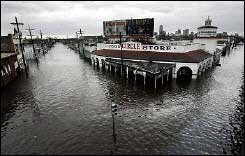
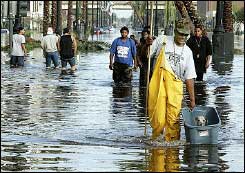
Katrina.

  • 100 Hours after Stormfall - a useful summary of events from The Anchoress.

  • Coverage - Austin Bay recommends the New Orleans Times-Picayune for its outstanding coverage, including this article on the devastating loss of legal documents -- real estate records dating back to the early 1800s, and the loss of offices, files and other documents critical to civil and criminal legal cases, making for a beaurocratic nightmare as New Orleans' citizens struggle to rebuild.

  • Disaster Relief - Katrina Help WIKI [mirror-site] has a lot of resources; the bloggers at Little Green Footballs provide an extensive list of charities; Mark Shea recommends the Mercy Corps; Amy Welborn has another good list explaining what you can do to help (see her blog for ongoing updates as usual).

  • If you live in the SouthEast and approximately 300 miles of the disaster area, HurricanHousing.org is coordinating offers of free housing to hurricane evacuees. (One of the few organizing projects by MoveOn.org that I'll support). Operation: Share Your Home is a similar project, run by "concerned Louisiana citizens who have joined together to provide an immediate response to the tragedy that has struck our beloved state."

  • The Knights of Columbus has pledged a minimum of $2.5 million in financial assistance and will match any funds beyond that donated to the Knights of Columbus Katrina Relief Fund over the next 60 days.

  • Lee Scott, President and CEO of Wal-Mart, America's largest retailer, pledged $15 million to relief efforts, along with the promise to establish "mini-Wal-Mart stores in areas impacted by the hurricane. Items such as clothing, diapers, baby wipes, food, formula, toothbrushes, bedding and water will be given out free of charge to those with a demonstrated need." This display of generosity even while its stores in New Orleans were being looted and ransacked -- one wonders if this might earn a nod of grudging approval from the radical left? (Via Cries in the Night).

  • Karen W. Woods, Director for the Center for Effective Compassion at the Acton Institute, reminds us that when it comes to relief "It's in the details":
    The first thing to remember is the principle of subsidiarity. The idea is common sense: Nothing should be done by larger and more complex organizations which can be done as well by smaller, simpler organizations closer to the need. In other words, leave the complex problems to the complex organizations; let the simpler groups take care of the more basic needs. . . . Local charities have been meeting local needs for decades. The ABC Pregnancy Resource Center in Lake Charles, La., delivered baby formula and baby clothes from their own program to a community center that is housing 2,500 Katrina refugees, with as many as 4,000 more expected this week. This community charity had the resources on hand and simply transferred them to the place of need. "I don't even have to ask my board," said director Nete Mire.

    But the ABC Pregnancy Center in Lake Charles (email: abcpregnancycenter@copper.net, 866-434-2797) needs more formula, diapers, baby wipes, and baby bath products. They are trying to help serve 116 children under age 2 at the com munity center. The nonprofit Tutwiler Clinic in Tutwiler, Miss. would immediately use financial donations for prescription drugs for refugees. Dr. Anne Brooks says such donations would also help them replace household items for those in their community who lost homes. Both these programs are listed in the Samaritan Guide, www.samaritanguide.com, a reporting site for privately funded charities that serve individuals.

    The Lake Charles Catholic Diocese is accepting donations for Katrina refugee assistance specifically in that community.

    The principle of subsidiarity not only offers a more efficient means for relief of basic needs, it offers a component that no bureaucracy could provide, one that only individuals can provide: a human connection. Only an individual can provide the hope and encouragement that is as necessary to the well being of these refugees.

  • A strange place to build a city. Kevin Miller (Heart, Mind & Strength) posts a good geographical representation of NOLA's location with respect to Lake Ponchartrain and the Gulf.

  • Will New Orleans Recover?, by Nicole Gelinas. City Journal Vol. 15, No. 3, Summer 2005:
    The truth is that even on a normal day, New Orleans is a sad city. Sure, tourists think New Orleans is fun: you can drink and hop from strip club to strip club all night on Bourbon Street, and gamble all your money away at Harrah’s. But the city’s decline over the past three decades has left it impoverished and lacking the resources to build its economy from within. New Orleans can’t take care of itself even when it is not 80 percent underwater; what is it going to do now, as waters continue to cripple it, and thousands of looters systematically destroy what Katrina left unscathed? . . .

    Nicole describes NO as a city having "long suffered from incompetence and corruption", illustrating the necessity of moral renewal of local government, concurrent with economic and social rehabilitation.

  • Oswald Sobrino (Catholic Analysis) takes issue with the "Hurricane Finger-Pointers", the Bush-haters who lay the blame for the chaos in NO at the feet of the President. Sobrino, a native New Orleanian, describes his hometown as "the city that did not evacuate in the face of a Category 5 hurricane", and concurs with Gelinas' report:
    The scandalous ineptness and stupidity shown by local and state officials in failing to enforce and implement a true evacuation of the most vulnerable is, unfortunately, a continuation of the long history of misrule that has marked my native city for decades. Remember that fact when you see local and state officials lashing out at the federal response. Their lashing out is an attempt at distracting from their own obvious responsibility for a self-magnified disaster.

  • Peter Sean Bradley (Lex Communis also has questions about New Orleans and its tradition of local governance, noting "hundreds of school buses in dirty contaminated water. School buses which were not sent to the Superdome on Saturday to evacuate those without transportation." What happened?

  • From Captain's Quarters and related bloggers, several good posts on the failure of local government, pointing out that 1) New Orleans had the opportunity to address the issues concerning emergency evacuation of a city nearly one year ago, in the advance of Hurrican Ivan in the Gulf; 2) that New Orleans' city government actually possessed a detailed hurricane disaster plan that it neglected to follow. Likewise, Americans for Freedom provides "a documented list of state and local failures" demonstrating why one cannot lay the blame for this on the federal government and the President.

  • Michael Novak finds that a look at the 2000 census data on New Orleans provides A Fuller Picture to the troubling images we're seeing on television.

  • From Arthur Chrenkoff:
    Arguably not as stupid and inane as some of the quotes following the Asian tsunami (see here and here), one of the biggest natural disasters in American history has nevertheless provided many with a delicious opportunity to bash President Bush and the right side of the politics and the country generally. Here's the selection of some of the choiciest commentary . . .

    (More quotes here).

  • Genevieve Kineke (Feminine Genius) relays a story of order amidst the chaos, which she describes as : "heart-rending because of the effort to create order as a sign of civility, which seems not to have mattered in the Big Picture. Of course, it does matter -- to those in this small place, to those struggling with despair, and to God." Pray that they get help.

  • 64-year old African American "social justice advocate" Randall Robinson claims that "black hurricane victims in New Orleans have begun eating corpses to survive". As opposed to, say, white hurricane victims, who possessing average human metabolisms can average 30 days without eating.

  • Fr. Jim Tucker admonishes those who foolishly ask What Did They Do to Deserve a Hurricane? -- meanwhile, Senior Kuwaiti Official did exactly that, proclaiming: "Katrina is a Wind of Torment and Evil from Allah Sent to This American Empire."

  • "This journal has become the Survival of New Orleans blog," says the author. "In less perilous times it was simply a blog for me to talk smack and chat with friends. Now this journal exists to share firsthand experience of the disaster and its aftermath with anyone interested."

  • Jimmy Akin brings his moral analysis to bear on a number of issues involving "disaster ethics" that have arisen in the past week. In part 1, he discusses "price gouging" and "the possibility, in situations of urgent necessity, of taking another's property without it being the sin of stealing"; in part two, moral situations which might justify the taking of another's property; in part three, what things you are allowed to take in such situations and what other rules there are concerning taking them".

  • Pope/St. Gregory the Great on Tribulation, Grieving the Dead, and Caring for the Living, from Teresa Polk (Blog By The Sea).

  • Finally, if I may be permitted to close with a bit of humor and advice -- Sean Penn, STAY OUT OF NEW ORLEANS. Go back to Hollywood, and let the real (i.e, trained) rescue crews do their job.

Friday, August 12, 2005

What kind of community does the Internet build?

. . . perhaps the Internet does build "community," but what kind of community does it build?

It seems to me that, even in "community," the Internet is inherently isolating, depending as it does on corrupt notions of freedom and selfhood. The Internet may be the greatest tool of the modern age, but it comes with all the problematic dualities that this age and its products have had--both for good and bad, for weal and woe, for liberation and enslavement. Yet many today are unable to understand both the boon and the bane of the Internet, that it can, even while creating community, radically undermine community, and thus foster isolation.

The Internet is isolating because it subtly convinces people that fellowship and community can be had with only as much commitment as a click of a button. If I get bored, or frustrated, or angry, or hurt online, I can just log off, or connect to a different forum. The Internet is the ultimate voluntary society. And the voluntaristic impulse embedded in online interactions is destructive of real community. It erodes trust, and renders impossible the collective building of a shared history and a shared set of ideals.

The church, as a community, must do more than simply bless such an idea of community with tacit acceptance. Rather, the church ought to challenge it by living an authentic alternative. In preaching, worship, catechesis, and mission, the church has the opportunity to subvert the voluntaristic model of community many people learn from modern life, and from its most effective pedagogue, the Internet. The church can preach the good news that God in Christ established a community transcending our voluntarism. The church can teach about the meaning of the Gospel to an information-saturated people. And in mission with and among these same people the church can live out a constancy and patience that will not "log off" when times are difficult and relationships are strained.

Daniel M. Griswold - "Beyond the Hype: The Internet and the Church" Perspectives: Journal of Reformed Christian Thought January 2003.

Thursday, August 04, 2005

Never had a problem with tap water, anyway.

. . . Ounce for ounce, it costs more than gasoline, even at today's high gasoline prices; depending on the brand, it costs 250 to 10,000 times more than tap water. Globally, bottled water is now a $46 billion industry. Why has it become so popular?

It cannot be the taste, since most people cannot tell the difference in a blind tasting. Much bottled water is, in any case, derived from municipal water supplies, though it is sometimes filtered, or has additional minerals added to it.

Nor is there any health or nutritional benefit to drinking bottled water over tap water. In one study, published in The Archives of Family Medicine, researchers compared bottled water with tap water from Cleveland, and found that nearly a quarter of the samples of bottled water had significantly higher levels of bacteria. The scientists concluded that "use of bottled water on the assumption of purity can be misguided." Another study carried out at the University of Geneva found that bottled water was no better from a nutritional point of view than ordinary tap water.

. . . Bottled water is undeniably more fashionable and portable than tap water. The practice of carrying a small bottle, pioneered by supermodels, has become commonplace. But despite its association with purity and cleanliness, bottled water is bad for the environment. It is shipped at vast expense from one part of the world to another, is then kept refrigerated before sale, and causes huge numbers of plastic bottles to go into landfills.

Of course, tap water is not so abundant in the developing world. And that is ultimately why I find the illogical enthusiasm for bottled water not simply peculiar, but distasteful. For those of us in the developed world, safe water is now so abundant that we can afford to shun the tap water under our noses, and drink bottled water instead: our choice of water has become a lifestyle option. For many people in the developing world, however, access to water remains a matter of life or death.

"Bad to the Last Drop", by Tom Standage. New York Times August 1, 2005.

Sunday, July 17, 2005

Pope Benedict and Harry Potter

Pope Benedict and Harry Potter @ The Ratzinger Fan Club.

A roundup of the relevant posts and articles for those interested in this truly momentous and controversial issue of international, nay, universal proportions.

Friday, June 17, 2005

Michael Foucault and Militant Islam

Heidegger had his infatuation with National Socialism. Sartre with Communism; and Focoult with . . . Radical Islam? -- Alas, according to Kevin Anderson and Janet Afary's Foucault and the Iranian Revolution (University of Chicago Press, 2005). The Boston Globe has the story:
When Foucault went to Tehran, he was France's dominant public intellectual, famous for a critique of modernity carried out through unsparing dissections of modern institutions that reversed the conventional wisdom about prisons, madness, and sexuality. In his most famous work, "Discipline and Punish," Foucault argued that liberal democracy was in fact a "disciplinary society" that punished with less physical severity in order to punish with greater efficiency. More broadly, his counternarrative of the Enlightenment suggested that the modern institutions we imagined were freeing us were in fact enslaving us in insidious ways. . . .

Foucault was virtually alone among Western observers, Anderson and Afary argue, in embracing the specifically Islamist wing of the revolution. Indeed, Foucault pokes fun at the secular leftists who thought they could use the Islamists as a weapon for their own purposes; the Islamists alone, he believed, reflected the "perfectly unified collective will" of the people.

The Iranian Revolution, Anderson and Afary write, appealed to certain of Foucault's characteristic preoccupations — with the spontaneous eruption of resistance to established power, the exploration of the limits of rationality, and the creativity unleashed by people willing to risk death. It also tied into his burgeoning interest in a "political spirituality" (by which he meant the return of religion into politics, a suspicious phenomenon in rigorously secular France) whose rise was then still obscured by the Cold War. These preoccupations made Foucault both more sensitive to the power of political religion, but also more prone to soft-pedal its dangers. In his articles, Foucault compared the Islamists to Savonarola, the Anabaptists, and Cromwell's militant Puritans. The comparisons were intended to flatter. . . .

There is a long tradition of Western intellectuals going abroad to sing the praises of revolutionaries in distant lands and finding in them the realization of their own intellectual hopes. But the irony of Foucault's embrace of the Iranian Revolution was that the earlier intellectuals who had sung hymns to tyrants tended to share a set of beliefs in the kind of absolutes — Marxism, humanism, rationality — that Foucault had made it his life's work to overturn. Rather than pronounce from on high, Foucault sought to listen to what he took to be the authentic voice of marginal people in revolt and let it speak through him. In practice, this turned out to be a distinction without a difference.

The philosopher and the ayatollah, by Wesley Yang. The Boston Globe June 12, 2005.

Herbert on Heideggar

Did you know Franklin Herbert -- most popular for his SF novel/series Dune -- wrote a novel loosely-based on the philosophy of Martin Heideggar? It's called The Santaroga Barrier.

The Heideggerian philosophy blog Enowning relays the story and a brief critical review. For those who aren't amused and/or impressed by Herbert's literary exercise, try browsing a copy of Heidegger's 1927 Sein und Zeit ["Being and Time"] next time you're at a bookstore, and imagine rendering it as fiction.

Sudoku.

Sudoku Clarification - Eamon Fitzgerald provides some background on a logic-game that's captured my interest as of late. It was introduced to me by a friend who plays it every morning. "Better than coffee," she says. I'm not sure I'd make the same comparison, but it is enjoyable and -- warning! -- potentially addictive.