Monday, October 11, 2004

TV On The Radio

I've recently discovered TV On The Radio and have been listening to them non-stop. There's not much to see on the website, but I recommend their albums Desperate Youth, Blood Thirsty Babes and the Young Liars EP.

Psychedelic, hypnotic, repetitive, innovative, moody, groovy, dark, soothing. To get a feel for them, check out their video to Staring at the Sun, which drew me to explore the rest of their music. Tell me what you think.

Sunday, October 10, 2004

Democracy comes to Afghanistan

The Afghan Election in Pictures and The Afghan Election in Words, courtesy of The Argus ("watching central Asia and the Caucasus").

A very fine blog.

Saturday, October 09, 2004

Jacques Derrida, R.I.P.

"Postmodernist" philosopher Jacques Derrida died today. He was 74.

David Brooks and Paul Bremer counter liberal distortions

In "The Report That Nails Saddam", New York Times Oct. 9, 2004), David Brooks dismantles the spin and distortion of the Duelfer Report on Iraq:

. . . Duelfer makes clear on the very first page of his report that it is a story. It is a mistake and a distortion, he writes, to pick out a single frame of the movie and isolate it from the rest of the tale.

But that is exactly what has happened. I have never in my life seen a government report so distorted by partisan passions. The fact that Saddam had no W.M.D. in 2001 has been amply reported, but it's been isolated from the more important and complicated fact of Saddam's nature and intent.

But we know where things were headed. Sanctions would have been lifted. Saddam, rich, triumphant and unbalanced, would have reconstituted his W.M.D. Perhaps he would have joined a nuclear arms race with Iran. Perhaps he would have left it all to his pathological heir Qusay.

We can argue about what would have been the best way to depose Saddam, but this report makes it crystal clear that this insatiable tyrant needed to be deposed. He was the menace, and, as the world dithered, he was winning his struggle. He was on the verge of greatness. We would all now be living in his nightmare.

  • Paul Bremer was also compelled to correct similar distortions of his remarks by the mainstream press ("What I Really Said About Iraq" New York Times Oct. 8, 2004):

    In recent days, attention has been focused on some remarks I've made about Iraq. The coverage of these remarks has elicited far more heat than light, so I believe it's important to put my remarks in the correct context.

    In my speeches, I have said that the United States paid a price for not stopping the looting in Iraq in the immediate aftermath of major combat operations and that we did not have enough troops on the ground to accomplish that task. The press and critics of the war have seized on these remarks in an effort to undermine President Bush's Iraq policy. . . .

    The press has been curiously reluctant to report my constant public support for the president's strategy in Iraq and his policies to fight terrorism. I have been involved in the war on terrorism for two decades, and in my view no world leader has better understood the stakes in this global war than President Bush.

    Can we say, "liberal bias in the media"?

  • Friday, October 08, 2004

    The Duelfer Report and Kerry's "Global Test"ers

    • Glenn Reynolds lays out the complete collapse of John Kerry's foreign policy case, and the reason for that collapse.
    • For those who don't have time to read 1000+ pages of the Duelfer report, Pearly Gates takes some time out of blogging baseball to provide a useful summary of relevant points pertinent to the debate on U.S. foreign policy.
    • Turns out Saddam bribed politicians around world to secure an early lifting of sanctions, according to Robin Gedye, Foreign Affairs Writer of the Telegraph. Likewise, according to The Scotsman, Hussein paid off Russia, France and China (three of the five UN Security Council members with the power to veto war) to keep the United States at bay:

      Tariq Aziz, the former Iraqi deputy prime minister, told the ISG that the "primary motive for French co-operation" was to secure lucrative oil deals when UN sanctions were lifted. Total, the French oil giant, had been promised exploration rights.

      Iraqi intelligence officials then "targeted a number of French individuals that Iraq thought had a close relationship to French President Chirac," it said, including two of his "counsellors" and spokesman for his re-election campaign.

      They even assessed the chances for "supporting one of the candidates in an upcoming French presidential election." Chirac is not mentioned by name.

    These are the countries John Kerry wants to appeal to for a "global test" concerning the U.S.' credibility to protect itself by preemptive measures?

    Sunday, October 03, 2004

    John Kerry's "Global Test" - Fallout and Feedback

    Kerry: No president, through all of American history, has ever ceded, and nor would I, the right to preempt in any way necessary to protect the United States of America.

    But if and when you do it, Jim, you have to do it in a way that passes the test, that passes the global test where your countrymen, your people understand fully why you're doing what you're doing and you can prove to the world that you did it for legitimate reasons.

    Here we have our own secretary of state who has had to apologize to the world for the presentation he made to the United Nations.

    Bush: Let me -- I'm not exactly sure what you mean, "passes the global test," you take preemptive action if you pass a global test.

    My attitude is you take preemptive action in order to protect the American people, that you act in order to make this country secure.

    Transcript Bush - Kerry Presidential Debate, Sept. 30, 2004.

    In related news . . .

    Monday, September 27, 2004

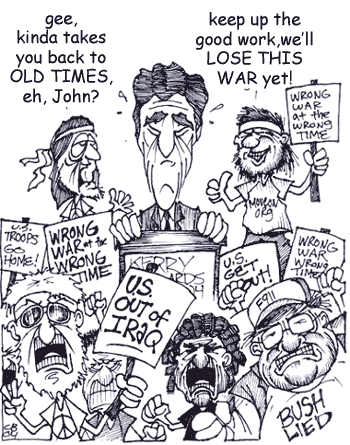
    John Kerry Has a Strange Way of Boosting Troop Morale

    On September 7th, John Kerry accused President Bush of sending U.S. troops to the "wrong war in the wrong place at the wrong time" and said he'd try to bring them all home in four years. Bush rebuked him for taking "yet another new position" on the war.

    (Source: Associated Press).

    Get the POSTCARD!
    (previous cartoon)

    Good News from Iraq, Part Eleven

    Arthur Chrenkoff has posted the latest (eleventh) installment of Good News from Iraq, with all the information you're likely to have missed if your sole source of news is the MSM (Mainstream Media), or listening to John Kerry's presidential campaign.

    Take his advice: "Read the stories below in addition to - not to the exclusion of - all the bad news. Only by knowing both sides of the story you can make an informed judgment about how things in Iraq are really going."

    Sunday, September 26, 2004

    David Brooks demolishes "the multilateral approach."

    "Another Triumph for the U.N.", by David Brooks. New York Times Sept. 25, 2004.

    A simply brilliant piece of writing that utterly demolishes the effectiveness of the U.N. and John Kerry's appeal for a 'multilateral' approach.

    Sometimes, you just have to go it alone.

    Saturday, September 25, 2004

    Paul Berman on "The Cult of Che"

    The cult of Ernesto Che Guevara is an episode in the moral callousness of our time. Che was a totalitarian. He achieved nothing but disaster. Many of the early leaders of the Cuban Revolution favored a democratic or democratic-socialist direction for the new Cuba. But Che was a mainstay of the hardline pro-Soviet faction, and his faction won. Che presided over the Cuban Revolution's first firing squads. He founded Cuba's "labor camp" system—the system that was eventually employed to incarcerate gays, dissidents, and AIDS victims. To get himself killed, and to get a lot of other people killed, was central to Che's imagination. In the famous essay in which he issued his ringing call for "two, three, many Vietnams," he also spoke about martyrdom and managed to compose a number of chilling phrases: "Hatred as an element of struggle; unbending hatred for the enemy, which pushes a human being beyond his natural limitations, making him into an effective, violent, selective, and cold-blooded killing machine. This is what our soldiers must become …"— and so on. He was killed in Bolivia in 1967, leading a guerrilla movement that had failed to enlist a single Bolivian peasant. And yet he succeeded in inspiring tens of thousands of middle class Latin-Americans to exit the universities and organize guerrilla insurgencies of their own. And these insurgencies likewise accomplished nothing, except to bring about the death of hundreds of thousands, and to set back the cause of Latin-American democracy—a tragedy on the hugest scale. . . .

    Paul Berman, "The Cult of Che" Slate.com, Sept. 25, 2004.

    Berman is author of Terror and Liberalism, which builds a liberal rationale for the war on terror and critiques leftist intellectuals as Noam Chomsky who "who have applauded terrorism and tried to explain it as a rational response to oppression." (Publisher's Weekly). . . Another book to add to my reading list.

    I had a Che t-shirt in college; bought it in Ireland, of all places. Haven't worn it in ages.

    Update: Ken Wheaton has a good post on this as well, musing:

    [Che] fought. And he fought. And he fought. He worshipped war. It would cause one to wonder why American "pacifists" would sport Che shirts and banners ... if one didn't realize that such pacifists, especially college kids, were historically ignorant. And the rich irony here is that Che hated Americans, especially well-meaning middle class Americans.

    Update: "The Real Che", by Anthony Daniels. The New Criterion Vol. 23, No. 2. Oct. 2004.

    Anti-semitism and the attack on the "neo-cons"

    In his magnificent historial survey of terrorism and the development of "The Bush Doctrine" ("World War IV: How It Started, What It Means, and Why We Have to Win", Commentary magazine editor Norman Podhoretz observes that the attack on "neoconservatives" often betrays sentiments of a baser nature:

    . . . A cognate count in this indictment held that the invasion of Iraq had been secretly engineered by a cabal of Jewish officials acting not in the interest of their own country but in the service of Israel, and more particularly of Ariel Sharon. At first the framers and early spreaders of this defamatory charge considered it the better part of prudence to identify the conspirators not as Jews but as "neoconservatives." It was a clever tactic, in that Jews did in fact constitute a large proportion of the repentant liberals and leftists who, having some two or three decades earlier broken ranks with the Left and moved rightward, came to be identified as neoconservatives. Everyone in the know knew this, and for those to whom it was news, the point could easily be gotten across by singling out only those neoconservatives who had Jewish-sounding names and to ignore the many other leading members of the group whose clearly non-Jewish names might confuse the picture.

    This tactic had been given a trial run by Patrick J. Buchanan in opposing the first Gulf war of 1991. Buchanan had then already denounced the Johnny-come-lately neoconservatives for having hijacked and corrupted the conservative movement, but now he descended deeper into the fever swamps by insisting that there were "only two groups beating the drums . . . for war in the Middle East—the Israeli Defense Ministry and its amen corner in the United States." Among those standing in the "amen corner" he subsequently singled out four prominent hawks with Jewish-sounding names, counterposing them to "kids with names like McAllister, Murphy, Gonzales, and Leroy Brown" who would actually do the fighting if these Jews had their way.

    Ten years later, in 2001, in the writings of Buchanan and other paleoconservatives within the journalistic fraternity (notably Robert Novak, Arnaud de Borchgrave, and Paul Craig Roberts), one of the four hawks of 1991, Richard Perle, made a return appearance. But Perle was now joined in starring roles by Paul Wolfowitz and Douglas Feith, both occupying high positions in the Pentagon, and a large supporting cast of identifiably Jewish intellectuals and commentators outside the government (among them Charles Krauthammer, William Kristol, and Robert Kagan). Like their predecessors in 1991, the members of the new ensemble were portrayed as agents of their bellicose counterparts in the Israeli government. But there was also a difference: the new group had managed to infiltrate the upper reaches of the American government. Having pulled this off, they had conspired to manipulate their non-Jewish bosses—Vice President Cheney, Secretary of Defense Donald Rumsfeld, National Security Adviser Condoleezza Rice, and George W. Bush himself—into invading Iraq.

    Before long, this theory was picked up and circulated by just about everyone in the whole world who was intent on discrediting the Bush Doctrine. And understandably so: for what could suit their purposes better than to "expose" the invasion of Iraq—and by extension the whole of World War IV—as a war started by Jews and being waged solely in the interest of Israel?

    To protect themselves against the taint of anti-Semitism, purveyors of this theory sometimes disingenuously continued to pretend that when they said "neoconservative" they did not mean "Jew." Yet the theory inescapably rested on all-too-familiar anti-Semitic canards—principally that Jews were never reliably loyal to the country in which they lived, and that they were always conspiring behind the scenes, often successfully, to manipulate the world for their own nefarious purposes.

    Friday, September 24, 2004

    "That's my president, hooah!"

    President Bush, after a campaign appearance in Bangor, held his plane on the tarmac when he heard an MD-11 carrying 292 Army reservists and National Guard members was about to refuel here. For the troops, grimly heading toward an 18-to-24-month assignment in Iraq, it was a welcome lift. For Bush, who has been accusing his Democratic presidential opponent, Sen. John F. Kerry, of demoralizing the troops in Iraq by criticizing the war effort, it was a chance to demonstrate his devotion to the troops.

    "May God bless you all," the commander in chief said over the plane's public address system. "May God keep you safe." As he worked his way up and down the plane's aisles, posing for photographs, signing autographs and shaking hands, the happily surprised troops called out to him.

    "That's my president, hooah!" shouted Sgt. Wanda Dabbs, 22, a member of the 230th Area Support Group, a Guard unit from Tennessee. Others seconded her cheer. . . .

    Whatever their concerns about the dangers ahead, the troops on the plane were joyous when their commander in chief appeared. "I can guarantee you right now this is the best thing that ever happened to me in my lifetime," said Sgt. 1st Class Bill Freeman of the 230th, a Goodyear Tires worker in Tennessee and a Bush supporter.

    Bush Surprises Departing Troops With Gift -- Himself", by Dana Milbank. Washington Post Friday, Sept. 24, 2004.

    Chrenkoff brings Kerry down to size.

    "Face it, you and your merry company are just a pimple on the ass of an asterisk in a footnote of the history of progress from tyranny to freedom."

    Arthur Chrenkoff, commenting on the "only happy when it rains" attitude of Senator Kerry and his comrades towards Iraq, as demonstrated recently by his putdown of Iraqi Interim Prime Minister Ayad Allawi's speech at the U.N.

    Gregory Djerejia ("Belgravia Dispatch") isn't too happy with Kerry, either.

    Thursday, September 23, 2004

    Love it or leave it?

    Commenting on Victor Davis Hanson's editorial in the Wall Street Journal ("The U.N.? Who Cares?" Sept. 23, 2004), Thomas Krannawitter has a good suggestion for Kofi Annan:

    But nations that don’t know the principles or language of freedom will never achieve freedom. Hanson is right to point out that, “Like the U.N. membership itself, [Kofi Annan] enjoys the freedom, affluence and security of a New York, but never stops to ask why that is so or how it might be extended to others less fortunate.”

    If the United Nations does not think of America as a model of freedom to be followed by others around the globe -- if America is merely one among many nations, neither better nor worse but only different -- then maybe the U.N. should seriously consider relocating itself to some place such as…oh, maybe Libya. Any nation responsible enough to chair the United Nations Human Rights Commission should be responsible enough to host the United Nations, right?

    Or maybe the United Nations might move to Sudan? It might be instructive: when the Human Rights Commission meets to discuss violations of human rights, they could simply look out the window to witness beatings, gang rapes, and enslavement. What could make their discussions more edifying?

    How about it, Kofi? -- It's been said that "absence makes the heart grow fonder."

    Tuesday, September 21, 2004

    Rathergate and Postmodernism

    Frederick Turner derives a philosophical lesson from 'Rathergate' ("The Blogosphere and the Pajamaheddin"):

    For the last thirty years or so academic Humanities departments throughout the country had been teaching writing through the discipline of rhetoric, based on deconstructive theories of the indeterminacy and self-destructiveness of any text. Since words can only be defined by other words, and cannot refer outside the language world to self-sufficient present realities, the only valid speech or writing was that which persuades others, and enacts the power interests of the discourse-community with the highest political ideals. The concept of truth, of the "transcendental signified," had been parsed into absurdity: everything depended on what the meaning of is is, as our former President so ingeniously put it.

    Journalists in the mainstream media had imbibed these ideas with their education, and had melded them with the enthusiasm and hero-worship they had lavished on the intrepid reporters of the Watergate and Iran-Contra scandals. But in the process, fact-checking, critical editing, and sound research had all begun to erode. . . .

    The new tone that entered the blogosphere was a sense of responsibility to the truth. The bloggers looked around themselves and saw that nobody else had the powerful means, the democratic and distributed organization, the robust egalitarian truculence, and the absence of interest conflict to act as the truth's final guardian and court of appeal. The mainstream journalists had abdicated their responsibility, the political parties were obviously willing to bend the truth, the academy had philosophically repudiated the concept of truth, the courts were increasing based on adversarial rhetorical virtuosity, rather than the establishment of fact. So it was up to the bloggers.

    Monday, September 20, 2004

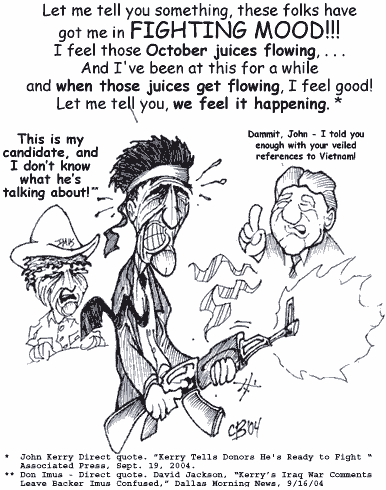
    Juiced-Up John Kerry in a "Fighting Mood"

    Cartoon by yours truly; inspired by blogger Tim Blair.

    Quick! Warn your friends! -- buy the postcard!
    greeting cards also available).

    Sunday, September 19, 2004

    When Journalism Meets Reality

    . . . This is a hard issue for journalists who want to be fair to partisans on both sides of the issue. Perhaps this small but symbolic action is, somehow, linked to the Peterson case. Perhaps it is linked to the growing use 4D ultrasound technology.

    Then again, perhaps it is a concession to reality, to the words that people use in real life. This is not politics. It is a matter of simple humanity. Faced with this kind of tragedy, loved ones and public servants do not tell journalists "we lost a fetus."

    No, they lost the baby. They lost a child, an "unborn child." It is awkward or even cruel to say anything else.

    TMatt, from the blog "Get Religion" (Ghost in the stylebook: Death of an unborn child).

    Friday, September 17, 2004

    Nice to know we still matter. =)

    . . . Queens today is often remembered primarily as the home of All in the Family’s Archie Bunker, the loudmouthed, blue-collar bigot invented by ultra-liberal Norman Lear. Bunker debuted during the Lindsay years, when the liberals looked with horror at how ordinary New Yorkers, especially from Queens’s ethnic neighborhoods, furiously resisted many of the progressive nostrums that Lindsay and his circle tried to force on them. Though Bunker evolved into a sort of genial, cartoonish figure, the show was part of a contemptuous assault against the ideals and values of the country’s blue-collar, family-oriented, ethnic middle class by the liberal elites of the time, who viewed resistance to their agenda as raw bigotry. But the citizens of Queens, for the most part, were not bigots, as Lear depicted them; and they were much wiser than John Lindsay, as the decline and revival of Queens -- and of New York as a whole -- makes clear. Let’s hope that the Manhattan elites don’t try to ride roughshod over the values and interests of the borough again. It won’t be just Queens that suffers.

    "Why Queens Matters", by Stephen Malanga.
    City Journal Summer 2004.

    John Kerry: Please. Shut. Up. About. VIETNAM.

    Kimberly Strassel has an amusing editorial on John Kerry's pathetic attempts to suck up to the NRA ("Ready, Aim, Fire . . . Hit Foot" Wall Street Journal Sept. 17, 2004), culminating in this excerpt from an upcoming issue of Outdoor Life:

    The October edition of Outdoor Life will feature interviews with both presidential candidates. When asked about their favorite guns, President Bush responds: "My favorite gun is a Weatherby Athena 20 gauge." Mr. Kerry says (reminding us yet again where he was 35 years ago): "My favorite gun is the M-16 that saved my life and that of my crew in Vietnam. I don't own one of those now, but one of my reminders of my service is a Communist Chinese assault rifle." So Mr. Kerry's favorite gun is an "assault" rifle designed for war. Funny talk coming from a guy who just went ballistic over the end of the "assault" weapons ban.

    I thought Bill Clinton called you from the hospital and advised you to cease and desist with all references to Vietnam?

    Please, it's really getting old.

    Thursday, September 16, 2004

    Kerry Supporter Harasses Three-Year-Old

    I don't care how mad you are at the President -- taking out your frustrations on a three-year-old by ripping up her 'Bush/Cheney' sign is bad form. Updates:
    • Here is a second photograph of the incident.

    • Was it staged as liberal blogger "Rising Hegemon" claims? -- The father, at least, has a habit of showing up at Democratic rallies with Bush/Cheney signs.
    • Washington Times has the story.
    • Update: Michelle Malkin has refuted the liberal claim that it was a hoax. Amazing how quickly the blog fact-checking machine springs into action. CBS should take lessons.